Key Points
- Court (Tribunale) of Rome, 16 January 2026: a trust beneficiary has no standing to seek the interim removal of s.r.l. directors under art. 2476, paragraph 3, cod. civ.
- Interim removal is characterised as a standalone measure, admissible even in the absence of a claim for damages: precisely for this reason, standing is confined to shareholders of the company concerned.
- In multi-tier shareholding chains, a shareholder of the parent company is not a shareholder of the subsidiary: there is no "bridge" to the subsidiary's internal corporate remedies.
- The effectiveness of protection for beneficiaries depends on the structure of the trust deed: the trustee's obligations, information and remedies in the event of inaction.
Trust beneficiary and standing to seek the removal of s.r.l. directors: the boundaries of art. 2476, paragraph 3, cod. civ.
(Court (Tribunale) of Rome, 16 January 2026)
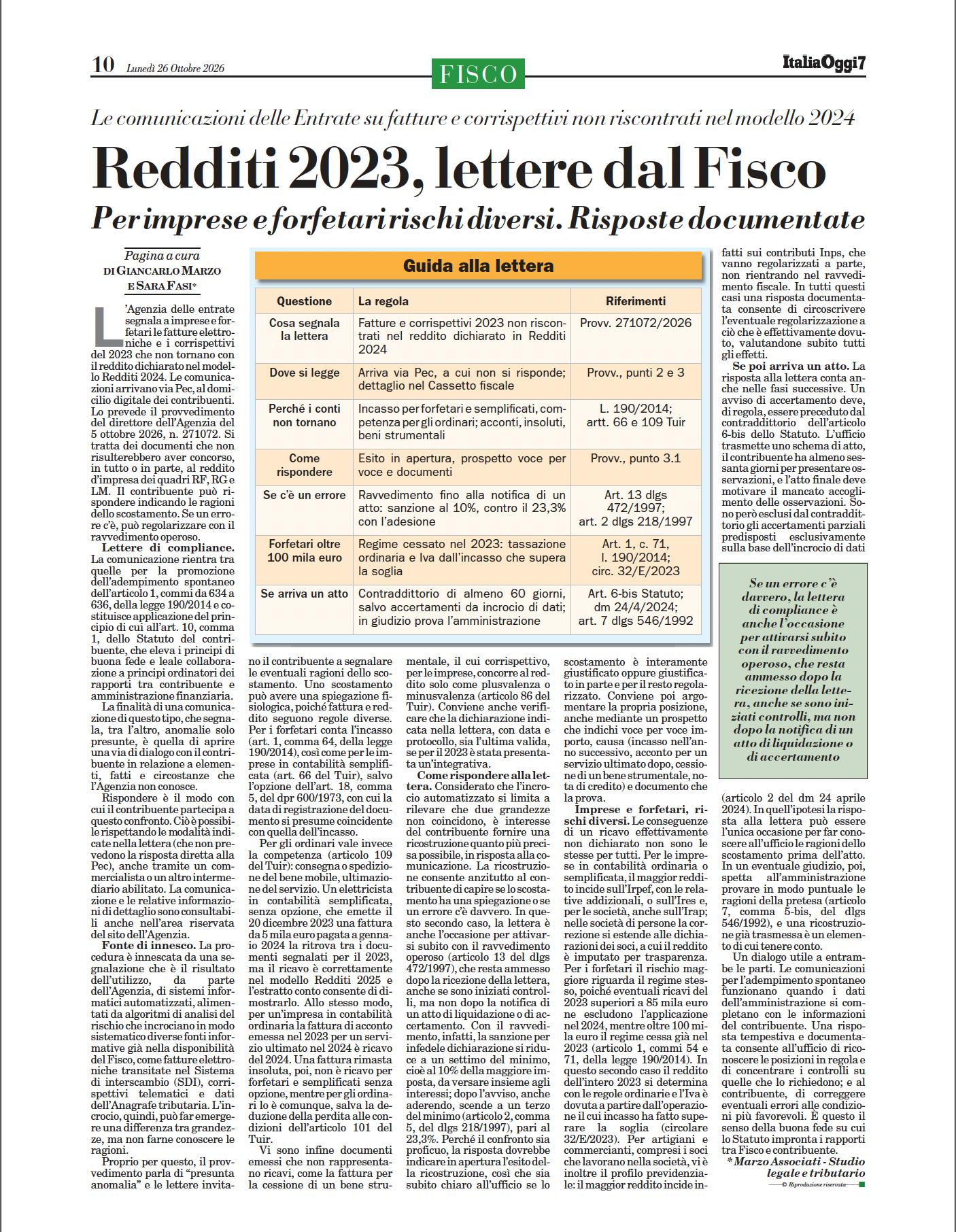
Marzo Associati, Legal and Tax Firm
Thesis. Characterising interim removal under art. 2476, paragraph 3, cod. civ. as a standalone measure has a restrictive consequence that has so far received little attention: it limits standing to shareholders of the company concerned, excluding shareholders of parent companies, trust beneficiaries and company creditors. The outcome reached in the order is persuasive: beneficiary status gives rise to a claim against the trustee, not an entitlement to access internal corporate remedies; merely reflective loss does not open up alternative avenues. Effective protection for the beneficiary must be built into the trust deed, rather than achieved by stretching corporate remedies.
Contents: § 1. The case - § 2. Interim removal as a standalone measure: a persuasive approach with a restrictive consequence - § 3. Standing to bring proceedings: strict adherence to the statutory wording and the limits of indirect shareholding - § 4. The applicants as company creditors: the correct application of the distinction between direct and reflective loss - § 5. The trust beneficiary and corporate remedies: a necessary separation - § 6. Practical implications and gaps in protection
§ 1. The case
The order of the Court (Tribunale) of Rome of 16 January 2026 arises from an appeal seeking the interim removal of the sole director of an Italian limited liability company situated at the lower end of a multi-tier shareholding chain, involving both matters of domestic company law and aspects relating to the rules governing a family trust.
The applicants each hold 5% of the capital of a holding company (hereinafter, the "parent company"), which holds 90% of another Italian limited liability company (hereinafter, the "subsidiary"), managed by the respondent. The remaining 10% of the subsidiary's capital is registered in the name of the mother of the director and of one of the applicants. In turn, 85% of the parent company is held by a corporate vehicle governed by English law and connected with a family trust, established by the parties' father before his death, of which the applicants claim to be beneficiaries. The subsidiary's assets – consisting mainly of properties located in Rome – are estimated at approximately €21.5 million.
As regards the allegations concerning management, the applicants allege a failure to approve the financial statements for the year ended 31 December 2024, as well as significant discrepancies between the rental income recorded in the financial statements for the 2023 financial year and the income expected in view of the extent of the property portfolio, with the amount recorded in the financial statements being approximately half the value estimated by the appointed consultant. On the basis of these circumstances, they invoke art. 2476, paragraph 3, cod. civ. and seek the interim removal of the director.
As a preliminary objection, the respondent challenges the jurisdiction of the Italian court. It should be clarified that the applicants base their claim on several grounds: they invoke their status as shareholders of the parent company, as beneficiaries of the family trust and as creditors of the subsidiary in their capacity as the settlor's heirs. In relation to jurisdiction, the respondent refers to the clause in the trust deed in favour of the English courts, as well as the applicants' lack of standing, since they are shareholders of the parent company and not of the subsidiary. The subsidiary itself, which entered an appearance through a special representative appointed under art. 78 cod. proc. civ., also objects to the applicants' lack of standing, while acknowledging that, in principle, there could be grounds for holding the management body accountable for the conduct complained of.
The order declares the appeal inadmissible for lack of standing, dismisses the respondent's counterclaim under art. 96 cod. proc. civ. and for damage to her professional reputation, and orders the applicants to reimburse both respondents' litigation costs.
§ 2. Interim removal as a standalone measure: a persuasive approach with a restrictive consequence
The first point of interest from a legal framework perspective concerns the classification of the claim. Although the heading of the appeal refers to art. 2476, paragraph 3, cod. civ. without further specification, the relief sought includes a request for the removal of the management body "by way of interim relief". The judge resolves the issue by correctly giving precedence to the relief sought over the heading of the document, in accordance with the principle – well established in procedural practice – that a party's true intention must be inferred from the relief actually sought, rather than from the statutory provision cited in the heading.
The more significant passage, however, concerns another point. The order affirms, in principle, the admissibility of interim removal of the management body even where no claim for damages has been brought beforehand or at the same time, expressly describing this approach as a new departure for the Division. From this perspective, interim removal is conceived as a means of protecting the integrity of corporate management in itself, detached from a merely ancillary function in relation to a monetary claim and capable of operating as a preventive safeguard against the continuation of seriously irregular management conduct.
In the author's view, this approach deserves full endorsement. Making interim removal conditional upon advance notice of a liability action would ultimately deprive the remedy of its primary function: ensuring an immediate legal response to ongoing, seriously irregular management, by requiring the shareholder to await the quantification of a loss that might worsen in the meantime. If the director has failed to approve the financial statements and rental income is inexplicably half the expected amount, the interest in ending the irregular management is current and concrete, and its protection cannot be made conditional upon the prior formulation of a claim for damages.
However, it is necessary to highlight a consequence of this construction which the order brings out particularly clearly and which, in the author's view, constitutes its most original contribution. Characterising interim removal as a standalone measure directly affects the range of persons with standing to bring proceedings. If removal is detached from a claim for damages, the persons entitled to seek it can only be those expressly identified in art. 2476, paragraph 3, cod. civ.: "each shareholder" of the company concerned. If, conversely, removal were characterised as ancillary to a claim for damages, the range of persons with standing could potentially expand, since it would be necessary to establish who is entitled to bring the liability action and, consequently, to seek the interim measure serving that action. This is a logical connection that has so far received little attention in discussions of the standalone nature of interim removal: broadening the substantive scope of the remedy (by detaching it from a claim for damages) entails, through a mechanism that may appear paradoxical, a restriction in its personal scope (confined to shareholders of the company concerned). Interim relief, precisely because it is intended to safeguard the internal arrangements for corporate management, remains confined to internal corporate relationships, thereby excluding persons who, although situated within the wider shareholding chain, are not themselves shareholders of the company to which the measure relates.
§ 3. Standing to bring proceedings: strict adherence to the statutory wording and the limits of indirect shareholding
The core reasoning of the decision focuses on defining the limits of standing to bring proceedings. The applicants hold shares in the parent holding company, but not in the subsidiary whose director they seek to remove. Since art. 2476, paragraph 3, cod. civ. confers the right to take action on "each shareholder", without providing for any extension to shareholders of parent companies or other persons situated at a higher level of the shareholding chain, the Court (Tribunale) concludes that standing remains confined to the shareholders of the company whose management body is to be removed.
This solution appears consistent not only with the wording of the provision, but also with its rationale. The removal remedy operates within the relationship of trust between the shareholders and directors of a particular company and presupposes an institutional connection with that specific body of shareholders. Allowing it to be invoked by persons without a direct shareholding relationship with the company concerned would alter the internal balance of corporate governance by introducing persons outside the shareholder body into the decision-making process. In this sense, the complete separation of the assets and liabilities of an Italian limited liability company from those of its shareholders operates as a structural limit on the extension of standing, preventing corporate control – even a substantial degree of control – from serving as a "bridge" to the subsidiary's internal corporate remedies.
The principle is not new in itself; its application to a shareholding structure involving a trust, however, introduces an additional layer of complexity, which the order addresses with commendable rigour. In this case, the shareholding chain is particularly intricate: the applicants are shareholders of the parent company, shares in the parent company are held by an English corporate vehicle, and that vehicle forms part of a family trust. At each stage, the legal person concerned changes, and so do the available remedies. The merit of the order lies in not allowing the complexity of the structure to influence its approach and in applying the statutory wording consistently: a shareholder of the parent company is not a shareholder of the subsidiary, whatever the chain of control connecting them.
An immediately apparent practical consequence follows: in multi-tier shareholding structures, a shareholder of the ultimate parent company wishing to respond to irregular management of a subsidiary has no direct action against the latter's governing bodies, but must approach the ultimate parent company so that it – as a shareholder of the subsidiary – invokes the remedies available to it under the law. If the ultimate parent company remains inactive, the shareholder's remedy lies, if anything, in a liability action against the directors of the parent company itself for failing to exercise shareholder rights with due diligence. In other words, the shareholding chain does not shorten the legal distance between the indirect shareholder and the company further down the chain.
§ 4. The applicants as company creditors: the correct application of the distinction between direct and reflective loss
A further aspect addressed by the order merits specific consideration. The applicants had not merely relied on their position as shareholders of the parent company and beneficiaries of the family trust, but had also asserted that they were creditors of the subsidiary in their capacity as the settlor's heirs. The Court (Tribunale) does not overlook this argument and devotes a significant passage of its reasoning to it, contributing to the overall coherence of the decision.
The judge observes that the management body's liability towards company creditors under art. 2476, paragraph 6, cod. civ. requires not only a finding that the allegations of mismanagement are well founded, but above all the existence of a causal link between the directors' conduct and financial loss suffered directly by the creditor: that is, harm that immediately affects the creditor's own assets and cannot amount merely to a reflection of the reduction in the company's assets.
The order rigorously applies the distinction between direct and reflective loss, now well established in the case law of the Italian Supreme Court (Corte di Cassazione). In this case, the harm alleged by the applicants would consist of a reduction in the value of the shareholdings and a diminution of the subsidiary's assets, which would spread along the shareholding chain until they affected the position of the trust beneficiaries. Such a situation – in which the individual creditor's financial loss is merely the indirect effect of the depletion of corporate assets – constitutes a typical instance of reflective loss, incapable of grounding liability under art. 2476, paragraph 6, cod. civ.
The order also adds an argument based on the legal framework which appears to deserve particular emphasis. Even leaving aside the reflective nature of the loss, company creditors cannot be regarded as having standing to seek the interim removal of the management body in the absence of advance notice of an intention to bring a liability action. This passage is significant because it gives full and consistent effect to the premise concerning the legal framework set out in § 2: standalone interim removal (above, § 2), precisely because it is characterised as a measure that is not ancillary to a claim for damages, remains reserved to shareholders of the company concerned. A creditor is not a shareholder and, under this framework, has no access to removal.
The internal consistency of the order's reasoning is commendable. The reasoning of the Court (Tribunale) thus comes full circle, closing off every possible route by which the applicants might seek interim removal: neither their status as shareholders of the parent company, nor their status as trust beneficiaries, nor their status as creditors of the subsidiary allows them to move beyond the range of persons defined by art. 2476, paragraph 3, cod. civ.
§ 5. The trust beneficiary and corporate remedies: a necessary separation
The aspect of greatest interest to readers of this Journal concerns the assessment of the applicants' position as trust beneficiaries. The Court (Tribunale) attributes merely factual significance to that status, describing their interest in the trust as the "unequivocal basis of the judicial application" made by the applicants, and rules out its providing standing to exercise the corporate remedies under art. 2476 cod. civ.
This conclusion appears not only correct, but necessary in light of the structure of the trust, under which the assets settled fall under the trustee's exclusive control and title for management purposes. It is the trustee who exercises – in their own name and in the interests of the beneficiaries – all powers relating to the trust assets, including the shareholder rights attached to any company shareholdings held within the segregated trust fund. In the normal operation of a trust, the beneficiary's position takes the form of an entitlement to make claims against the trustee – encompassing the right to an account of the administration, to the proper exercise of fiduciary powers and, where the relevant conditions are met, to the removal or replacement of the trustee under the law governing the trust – and does not translate into a power to act in the trustee's place in exercising management prerogatives relating to the trust assets.
To accept the contrary – that is, to allow the beneficiary to bring proceedings directly in the corporate sphere by invoking their position in the fiduciary relationship – would have two distorting consequences. On the one hand, it would circumvent the range of persons with standing under art. 2476, paragraph 3, cod. civ., by conferring standing on a person not contemplated by the provision. On the other, and perhaps more significantly, it would undermine the rules governing the trust relationship itself, under which the beneficiary's remedies are structured as claims against the trustee, rather than as direct powers over the corporate entities in which the trust assets are invested. In other words, the beneficiary has a claim against the trustee, not against the companies in which the trust holds shares.
The merit of the order lies in maintaining this separation, preventing conflict within the trust – in this case, a family dispute arising from a request to terminate the trust made by one of the applicants and repeatedly refused by the respondent – from translating into indiscriminate access to the subsidiary's internal corporate remedies. This observation is particularly significant when one considers that, in the proceedings under examination, the application for interim removal appears to have been the procedural transposition of a conflict whose natural setting is the fiduciary relationship, not the corporate relationship. The order appropriately preserves their distinct spheres.
§ 6. Practical implications and gaps in protection
The order is notable for the consistency with which it preserves the boundaries of the corporate remedies under art. 2476, paragraph 3, cod. civ., systematically closing off all possible routes to interim removal for persons other than shareholders of the company concerned. The result appears consistent both with the wording of the provision and with the rationale of the removal remedy and, overall, deserves full endorsement.
However, the problematic implications of this strict separation cannot be overlooked. In asset-holding arrangements characterised by the coexistence of trusts and multi-tier shareholding chains, a beneficiary who identifies harmful management of a subsidiary may find that protection is available only indirectly and potentially subject to delay. The natural remedy within the trust framework remains an action against the trustee: an account, a request for removal or replacement, or a claim for damages for breach of fiduciary duties. If, however, the trustee remains inactive or, worse, is complicit – a possibility that is not implausible in this case, where the English corporate vehicle forms part of a trust whose internal dynamics appear to be dominated by the family conflict between the parties – the beneficiary has no direct means of influencing the subsidiary's corporate management.
The practical lesson to be drawn from the case is therefore that the effectiveness of protection for beneficiaries in complex trust structures depends to a decisive extent on the structure of the trust deed. It appears appropriate for the trust deed to regulate precisely the trustee's obligation to exercise shareholder rights in the beneficiaries' interests, the arrangements for informing beneficiaries about the management of companies in which shares are held, and the remedies that can actually be pursued in the event of inaction or harmful conduct. Likewise, the inclusion in any shareholders' agreements of clauses granting the beneficiary the right to raise concerns or initiate action may help to fill the gap in protection highlighted by the decision. In the absence of such safeguards, as the order under examination confirms, the beneficiary remains confined to a sphere of indirect protection, mediated exclusively through the fiduciary relationship with the trustee, with a tangible risk of areas in which protection is ineffective against harmful management conduct at company level. The circumstances giving rise to the order are, indeed, a paradigmatic example.