Key Points
- What the letter flags: 2023 invoices and receipts not reflected in the income declared in Redditi 2024 (Order no. 271072 of 5 October 2026).
- Where to read it: it arrives by certified email (PEC), which should not be replied to; details of the documents are available in the taxpayer's online tax account (Cassetto fiscale).
- Why the figures may not match: cash basis for flat-rate taxpayers and businesses using simplified accounting, accruals basis for those using ordinary accounting; advance payments, unpaid invoices and capital assets.
- If there is an error: voluntary disclosure (ravvedimento operoso) is available until a formal notice is served, with a 10% penalty compared with 23.3% under the tax settlement procedure (accertamento con adesione).
- Flat-rate taxpayers exceeding €100,000: the regime ceases to apply as early as 2023, with ordinary taxation and VAT applying from the receipt of payment that exceeds the threshold.
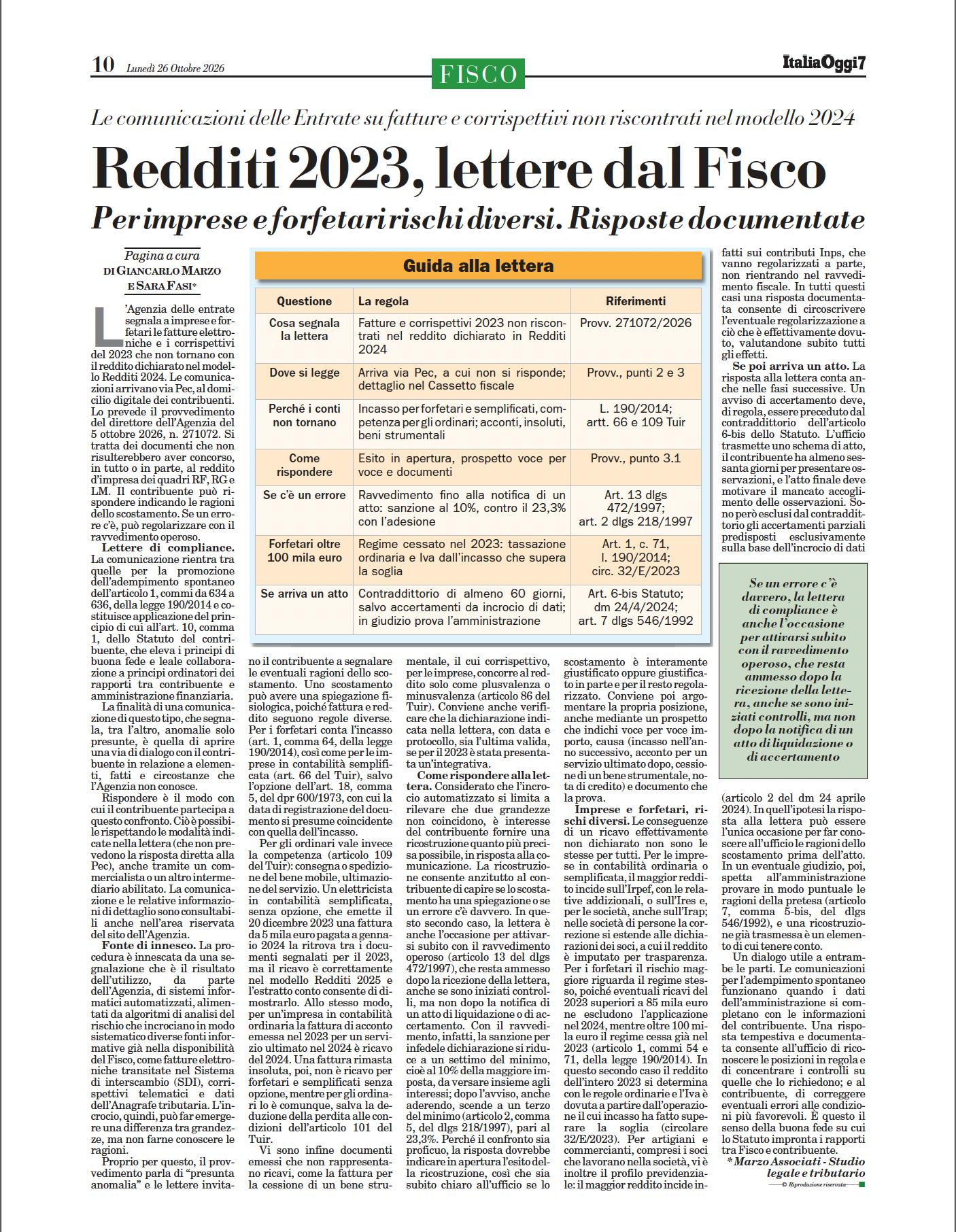
Guide to the letter
| Issue | The rule | References |
|---|---|---|
| What the letter flags | 2023 invoices and receipts not reflected in the income declared in Redditi 2024 | Order 271072/2026 |
| Where to read it | It arrives by certified email (PEC), which should not be replied to; details are available in the taxpayer's online tax account (Cassetto fiscale) | Order, paragraphs 2 and 3 |
| Why the figures do not match | Cash basis for flat-rate taxpayers and businesses using simplified accounting, accruals basis for those using ordinary accounting; advance payments, unpaid invoices and capital assets | L. 190/2014; Articles 66 and 109 of the Italian Income Tax Code (TUIR) |
| How to respond | State the outcome at the outset, followed by an item-by-item schedule and supporting documents | Order, paragraph 3.1 |
| If there is an error | Voluntary disclosure (ravvedimento operoso) is available until a formal notice is served: a 10% penalty, compared with 23.3% under the tax settlement procedure (accertamento con adesione) | Article 13 dlgs 472/1997; Article 2 dlgs 218/1997 |
| Flat-rate taxpayers exceeding €100,000 | The regime ceased to apply in 2023: ordinary taxation and VAT apply from the receipt of payment that exceeds the threshold | Article 1, paragraph 71, l. 190/2014; Circular 32/E/2023 |
| If a formal notice arrives | A prior consultation period of at least 60 days, except for assessments based on data matching; in litigation, the burden of proof rests with the tax authority | Article 6-bis of the Taxpayer's Charter; dm 24/4/2024; Article 7 dlgs 546/1992 |
Source: ItaliaOggi7, 26 October 2026, p. 10 — page edited by Giancarlo Marzo and Sara Fasi.
Following Order no. 271072 of 5 October 2026 issued by the Director of the Italian Revenue Agency (Agenzia delle Entrate), communications have begun to be sent to businesses and flat-rate taxpayers flagging electronic invoices and electronically reported receipts for 2023 which appear not to have contributed, in whole or in part, to the business income declared in the Redditi 2024 tax return (sections RF, RG and LM). The letters arrive by certified email (PEC), at the taxpayer's digital address for service. Giancarlo Marzo and Sara Fasi analysed the subject in ItaliaOggi7 on 26 October 2026: here we summarise the points relevant to recipients of the communication.
What the letter flags
This is a communication intended to promote voluntary compliance, provided for by Article 1, paragraphs 634 to 636, of legge 190/2014, implementing the principle of good faith and loyal cooperation under Article 10, paragraph 1, of the Taxpayer's Charter. The notification arises from automated matching of sources already available to the tax authority: invoices transmitted through the Exchange System (Sistema di interscambio), electronically reported receipts and data from the Tax Register (Anagrafe tributaria). The algorithm detects that two figures do not match, but does not know the reasons for the difference. This is why the Order refers to a "presumed" anomaly and invites the taxpayer to explain the discrepancy.
The certified email (PEC) should not be replied to directly: the letter sets out how to respond, and details of the flagged documents can be consulted in the taxpayer's online tax account (Cassetto fiscale). The response may also be submitted through an accountant or another authorised intermediary.
Why the figures may not match
Invoices and income follow different rules, and in many cases the discrepancy has an ordinary explanation.
- Flat-rate taxpayers determine income on a cash basis (Article 1, paragraph 64, legge 190/2014); the same applies to businesses using simplified accounting (Article 66 TUIR), unless they have made the election under Article 18, paragraph 5, of dpr 600/1973, whereby the date on which the document is recorded is presumed to coincide with receipt of payment.
- Businesses using ordinary accounting, by contrast, apply the accruals basis (Article 109 TUIR): what matters is the delivery or dispatch of the goods, or completion of the service.
It is also worth checking that the tax return identified in the letter by its date and reference number is the latest valid return: if an amended return has been filed for 2023, that is the return against which the comparison must be made.
How to structure the response
Since the data matching merely identifies a difference, it is in the taxpayer's interest to provide an accurate reconciliation. The response should begin with the outcome of the reconciliation, so that the tax office immediately understands whether the discrepancy is fully justified or partly justified and, for the remainder, rectified. This should be followed by an item-by-item schedule showing the amount, the reason (payment received in the following year, an advance payment for a service completed later, disposal of a capital asset, a credit note) and the document that substantiates it.
If there is indeed an error, the letter is an opportunity to initiate voluntary disclosure (ravvedimento operoso) immediately (Article 13 of d.lgs. 472/1997). Voluntary disclosure (ravvedimento operoso) remains available after receipt of the communication and even if checks have begun, but not after service of a tax calculation notice or tax assessment notice. The difference is significant: with voluntary disclosure (ravvedimento operoso), the penalty for an inaccurate return is reduced to one-seventh of the minimum, namely 10% of the additional tax, payable together with interest; after the tax assessment notice, even under the tax settlement procedure (accertamento con adesione), the reduction is to one-third of the minimum (Article 2, paragraph 5, d.lgs. 218/1997), equivalent to 23.3%.
Businesses and flat-rate taxpayers: different risks
The consequences of revenue that has actually gone undeclared vary according to the regime.
- For businesses using ordinary or simplified accounting, the additional income affects personal income tax (IRPEF) and the related surcharges, or corporate income tax (IRES) and, for companies and partnerships, regional tax on productive activities (IRAP) as well. In partnerships, the correction extends to the partners' tax returns, as the income is attributed to them on a tax-transparent basis.
- For flat-rate taxpayers, the main risk concerns the regime itself: revenue for 2023 exceeding €85,000 precludes application of the flat-rate regime in 2024; above €100,000, the regime ceases to apply as early as 2023 (Article 1, paragraphs 54 and 71, legge 190/2014). In the latter case, income for the whole of 2023 is determined under the ordinary rules, and VAT is due from the transaction whose payment caused the threshold to be exceeded (Circular 32/E/2023).
- For craftspeople and traders, including partners who work in the business, there is also a social security aspect: the additional income affects INPS (Italian social security institute) contributions, which must be regularised separately because they fall outside tax voluntary disclosure (ravvedimento operoso).
If a formal notice subsequently arrives
The response to the letter also matters at later stages. As a rule, a tax assessment notice must be preceded by the consultation procedure under Article 6-bis of the Taxpayer's Charter: the tax office sends a draft notice, the taxpayer has at least sixty days to submit observations, and the final notice must give reasons for not accepting them. However, partial assessments prepared exclusively on the basis of data matching are excluded from the consultation procedure (Article 2 of dm 24 April 2024). In that situation, the response to the letter may be the only opportunity to explain the reasons for the discrepancy to the tax office before the notice is issued.
Finally, in any litigation, it is for the tax authority to provide precise evidence of the grounds for its claim (Article 7, paragraph 5-bis, d.lgs. 546/1992): a reconciliation already submitted in response to the letter is an element that the court takes into account.
Communications promoting voluntary compliance work when the tax authority's data are supplemented by the taxpayer's information. A timely, documented response enables the tax office to identify compliant tax positions and the taxpayer to correct any errors on more favourable terms.
The full article by Giancarlo Marzo and Sara Fasi appears in ItaliaOggi7 of 26 October 2026.
Marzo Associati – Law and Tax Firm
For assistance in responding to the communication and at any subsequent stage, see the page on tax litigation; for a review of a business's tax position, see the page on business taxation.
Frequently Asked Questions
What does the Italian Revenue Agency (Agenzia delle Entrate) letter on 2023 revenue flag?
It flags to businesses and flat-rate taxpayers electronic invoices and electronically reported receipts for 2023 which appear not to have contributed, in whole or in part, to the business income declared in the Redditi 2024 tax return (sections RF, RG and LM), as provided for by Order no. 271072 of 5 October 2026.
How should the communication be answered?
The certified email (PEC) should not be replied to directly: the letter sets out how to respond, and details of the documents are available in the taxpayer's online tax account (Cassetto fiscale). The response, which may also be submitted through an accountant or another authorised intermediary, should begin with the outcome of the reconciliation, followed by an item-by-item schedule showing the amount, the reason and the document that substantiates it.
Does a discrepancy always mean there is an error?
No. Invoices and income follow different rules: flat-rate taxpayers and businesses using simplified accounting determine income on a cash basis, while businesses using ordinary accounting use the accruals basis. An invoice issued in December 2023 and paid in January 2024, an advance payment for a service completed in 2024 or an unpaid invoice may explain the difference.
Is voluntary disclosure (ravvedimento operoso) still available after the letter?
Yes. Voluntary disclosure (ravvedimento operoso) remains available after receipt of the communication and even if checks have begun, but not after service of a tax calculation notice or tax assessment notice. The penalty for an inaccurate return falls to 10% of the additional tax, compared with 23.3% after the tax assessment notice, even under the tax settlement procedure (accertamento con adesione).
What risks do flat-rate taxpayers face if their 2023 revenue exceeds €100,000?
Above €100,000, the regime ceases to apply as early as 2023: income for the whole year is determined under the ordinary rules, and VAT is due from the transaction whose payment caused the threshold to be exceeded (Circular 32/E/2023). With revenue exceeding €85,000, the flat-rate regime does not apply in 2024.
Giancarlo Marzo and Sara Fasi — Marzo Associati, Law and Tax Firm. Article published in ItaliaOggi7 on 26 October 2026.