Key Points
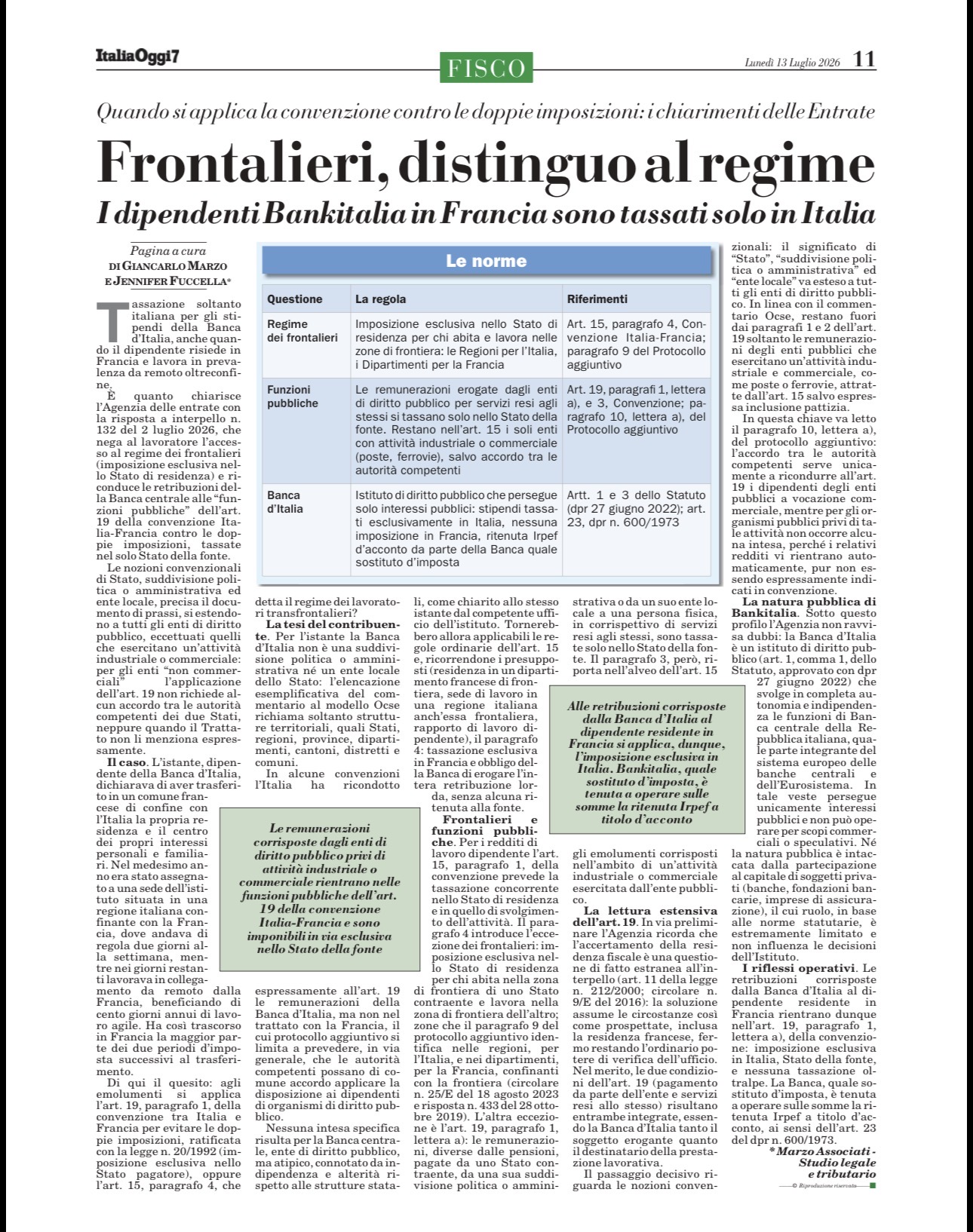
- Bank of Italy salaries paid to an employee resident in France who works predominantly remotely across the border are taxed only in Italy.
- The Italian Revenue Agency (Agenzia delle Entrate), in tax ruling (risposta a interpello) no. 132 of 2 July 2026, denies access to the cross-border workers regime (Article 15(4)) and brings the remuneration within Article 19 of the Italy–France Double Taxation Convention ("government service"), taxable solely in the source State.
- The treaty concepts of State, political or administrative subdivision and local authority extend to all bodies governed by public law, excluding only those carrying on an industrial or commercial activity.
- For "non-commercial" public bodies, no agreement is required between the competent authorities of the two States, even if the Treaty does not expressly mention them.
- The Bank of Italy, as an institution governed by public law forming part of the ESCB/Eurosystem, operates independently, pursuing only public interests: private entities' holdings in its capital do not affect its public nature.
- The Bank deducts personal income tax (IRPEF) withholding on account from the amounts under Article 23 of d.P.R. n. 600/1973.
The treaty concepts of State, political or administrative subdivision and local authority – the guidance document explains – extend to all bodies governed by public law, except those carrying on an industrial or commercial activity: for "non-commercial" bodies, the application of Article 19 does not require any agreement between the competent authorities of the two States, even where the Treaty does not expressly mention them.
The case
The applicant, an employee of the Bank of Italy, stated that he had transferred his residence and the centre of his personal and family interests to a French municipality bordering Italy. In the same year, he had been assigned to an office of the institution situated in an Italian region bordering France, where he generally attended two days a week, while on the remaining days he worked remotely from France, benefiting from one hundred days of flexible working a year. He thus spent most of the two tax periods following the move in France.
This gave rise to the question: does Article 19(1) of the convention between Italy and France for the avoidance of double taxation, ratified by legge n. 20/1992 (exclusive taxation in the paying State), apply to the remuneration, or does Article 15(4), which sets out the cross-border workers regime, apply?
The taxpayer's position
In the applicant's view, the Bank of Italy is neither a political or administrative subdivision nor a local authority of the State: the illustrative list in the Commentary on the OECD Model refers only to territorial structures, such as States, regions, provinces, departments, cantons, districts and municipalities.
In some conventions, Italy has expressly brought Bank of Italy remuneration within Article 19, but not in the treaty with France, whose additional protocol merely provides, in general terms, that the competent authorities may by mutual agreement apply the provision to employees of bodies governed by public law. There appears to be no specific agreement concerning the central bank, a body governed by public law but an atypical one, characterised by its independence and distinctness from State structures, as the institution's competent department had explained to the applicant himself.
The ordinary rules of Article 15 would therefore apply and, where the conditions are met (residence in a French border department, a workplace in an Italian region also on the border, and an employment relationship), paragraph 4: exclusive taxation in France and an obligation on the Bank to pay the entire gross remuneration, without any withholding at source.
Cross-border workers and government service
For employment income, Article 15(1) of the convention provides for concurrent taxation in the State of residence and the State where the activity is performed. Paragraph 4 introduces the exception for cross-border workers: exclusive taxation in the State of residence for those who live in the border area of one Contracting State and work in the border area of the other; areas which paragraph 9 of the additional protocol identifies as the regions, for Italy, and the departments, for France, adjoining the border (circular no. 25/E of 18 August 2023 and ruling no. 433 of 28 October 2019).
The other exception is Article 19(1)(a): remuneration, other than pensions, paid by a Contracting State, a political or administrative subdivision thereof or a local authority thereof to an individual in respect of services rendered to them is taxable only in the source State. Paragraph 3, however, brings remuneration paid in connection with an industrial or commercial activity carried on by the public body back within Article 15.
The broad interpretation of Article 19
As a preliminary point, the Agency recalls that determining tax residence is a question of fact outside the scope of a tax ruling request (Article 11 of legge n. 212/2000; circular no. 9/E of 2016): the conclusion assumes the circumstances as presented, including French residence, without prejudice to the tax office's ordinary verification powers. On the merits, both conditions under Article 19 (payment by the body and services rendered to it) are met, since the Bank of Italy is both the paying entity and the recipient of the employee's services.
The decisive point concerns the treaty concepts: the meaning of "State", "political or administrative subdivision" and "local authority" must be extended to all bodies governed by public law. In line with the OECD Commentary, only remuneration paid by public bodies carrying on an industrial and commercial activity, such as postal services or railways, falls outside paragraphs 1 and 2 of Article 19 and within Article 15, unless expressly included by treaty provision.
Paragraph 10(a) of the additional protocol must be read in this light: an agreement between the competent authorities is required solely to bring employees of commercially oriented public bodies within Article 19, whereas no agreement is needed for public bodies without such an activity, because the relevant income falls within it automatically, even though they are not expressly listed in the convention.
The public nature of the Bank of Italy
On this point, the Agency sees no doubt: the Bank of Italy is an institution governed by public law (Article 1(1) of its Statute, approved by d.P.R. 27 June 2022) which performs, with complete autonomy and independence, the functions of central bank of the Italian Republic, as an integral part of the European System of Central Banks and the Eurosystem. In that capacity, it pursues only public interests and cannot operate for commercial or speculative purposes.
Nor is its public nature affected by private entities' holdings in its capital (banks, banking foundations and insurance companies), whose role, under the statutory provisions, is extremely limited and does not influence the institution's decisions.
Practical implications
The remuneration paid by the Bank of Italy to the employee resident in France therefore falls within Article 19(1)(a) of the convention: exclusive taxation in Italy, the source State, and no taxation in France. The Bank, as withholding agent, is required to deduct IRPEF withholding on account from the amounts, pursuant to Article 23 of d.P.R. n. 600/1973.
References: Italian Revenue Agency (Agenzia delle Entrate), tax ruling (risposta a interpello) no. 132 of 2 July 2026; Italy–France Double Taxation Convention (legge n. 20/1992), Articles 15 and 19.