
Key Points
- Preferential corporate income tax (IRES): the ordinary rules apply to the employment requirement, with no special calculation method for seasonal workers (MEF clarification, 11 March 2026).
- Businesses employing summer seasonal workers risk exclusion from the relief: seasonal workers contribute to the three-year average but not to the year-end snapshot figure.
- The natural expiry of seasonal contracts is not among the exhaustively listed exclusions from the average baseline, resulting in an unfavourable comparison.
- The investment cap incorporated into the Redditi SC 2026 tax return form (lines RN8 and RN8A) takes account of the cost "remaining borne" by the business: an interpretative issue that remains unresolved.
How the preferential rate applies to businesses with fixed-term workers: MEF guidance
Page edited by Giancarlo Marzo
No favourable calculation method for businesses employing seasonal workers.
For the purposes of preferential IRES, namely the rate reduction from 24% to 20% reserved for those that invested and increased employment in 2025, no special method is provided for determining the employment requirement: the general rules apply, based on EU principles governing incentives.
The Ministry of Economy and Finance clarified this on 11 March 2026, in response to parliamentary question no. 5-05143 before the Finance Committee of the Chamber of Deputies, which had raised the risk of exclusion from the relief for businesses using seasonal labour during the summer months.
The parliamentary question
The question highlighted a difficulty in the procedure for calculating employment levels. Companies employing seasonal workers during the summer months risk being penalised, since these workers are included in the calculation of the three-year average but not in the year-end snapshot figure, with a result potentially contrary to the purpose of the provision: exclusion from the relief of companies that have nevertheless recorded an increase in permanent employment.
The relief
Introduced by art. 1, paragraphs 436-444, of law 30 December 2024, no. 207 (the 2025 Budget Law), preferential IRES consists, solely for the tax period following that in progress on 31 December 2024, of a rate reduction from 24% to 20% where a set of cumulative conditions is met: strengthening the company's equity, making "qualifying" investments, increasing employment and not using certain wage support schemes, subject to the grounds for forfeiture. It is a one-off measure, not renewed by the 2026 Budget Law.
The verification method
The central issue is art. 6, paragraph 2, of dm 8 August 2025. The employment growth condition, which art. 1, paragraph 437, of law 207/2024 links to the requirement that "the number of annual work units has not decreased compared with the average for the preceding three-year period", is verified by comparing the number of full-time equivalent employees in the final month of the tax period following that in progress on 31 December 2024 (December 2025) with the average for the preceding thirty-six months. Workers who left their posts during the period owing to voluntary resignation, disability, retirement on reaching retirement age, a voluntary reduction in working hours or dismissal for just cause are excluded from the average baseline.
The difficulty for seasonal workers
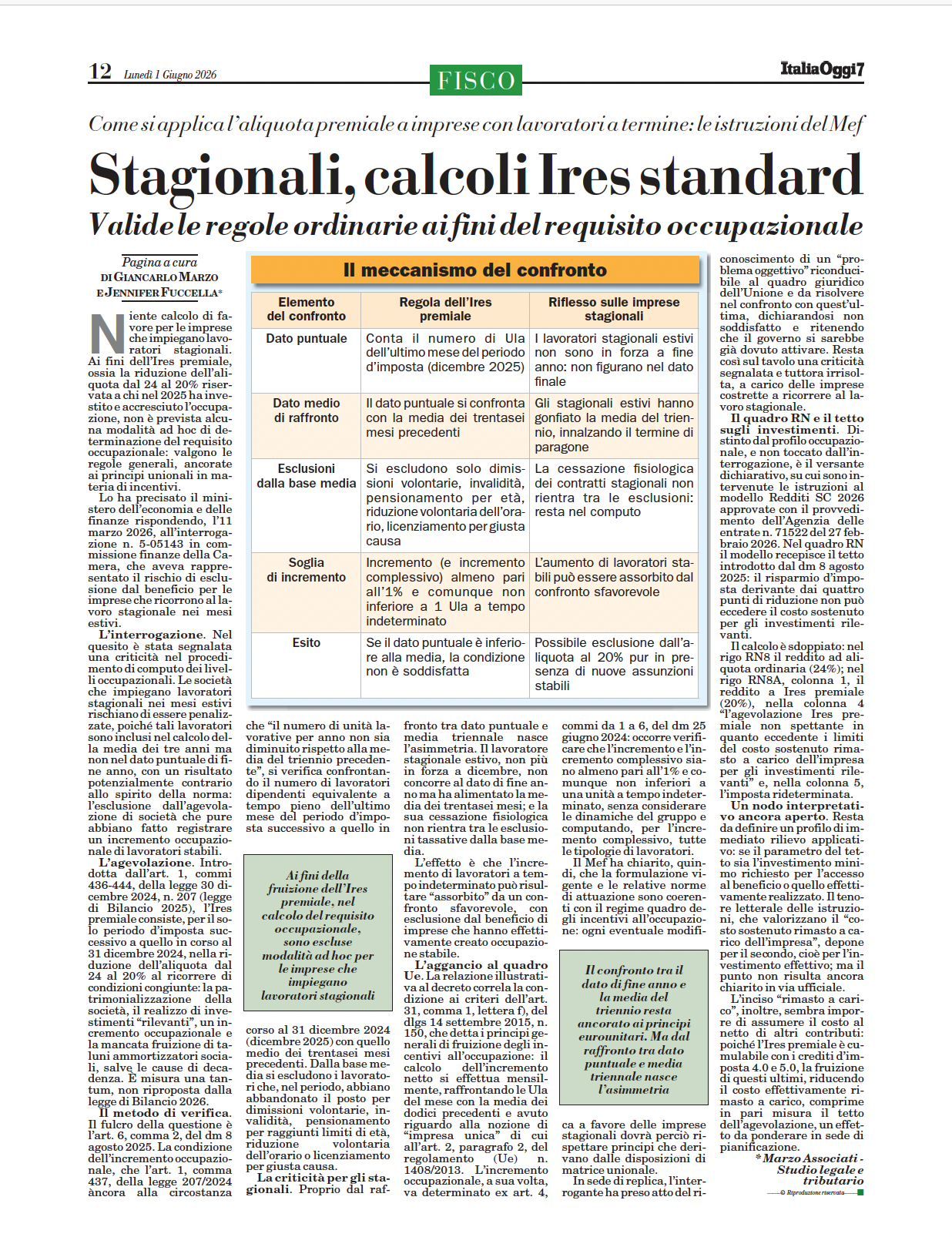
The asymmetry arises precisely from the comparison between a snapshot figure and a three-year average. A summer seasonal worker who is no longer employed in December does not contribute to the year-end figure but has contributed to the thirty-six-month average; and the natural expiry of their employment is not among the exhaustively listed exclusions from the average baseline. The effect is that an increase in permanent workers may be "absorbed" by an unfavourable comparison, excluding businesses that have genuinely created permanent employment from the relief.
The link to the EU framework
The explanatory report accompanying the decree links the condition to the criteria in art. 31, paragraph 1, letter f), of dlgs 14 September 2015, no. 150, which lays down the general principles for claiming employment incentives: the net increase is calculated monthly, comparing the annual work units for the month with the average for the preceding twelve months and taking account of the concept of a "single undertaking" under art. 2, paragraph 2, of Regulation (EU) no. 1408/2013. The employment increase, in turn, must be determined under art. 4, paragraphs 1 to 6, of dm 25 June 2024: it is necessary to verify that both the increase and the overall increase are at least 1% and, in any event, no less than one permanent employee, disregarding changes within the group and counting all categories of workers for the overall increase. MEF therefore clarified that the current wording and the associated implementing provisions are consistent with the framework governing employment incentives: any amendment in favour of seasonal businesses must therefore comply with principles deriving from EU provisions.
In reply, the member who tabled the question acknowledged the recognition of an "objective problem" attributable to the EU legal framework and to be resolved through dialogue with the EU, expressing dissatisfaction and taking the view that the government should already have taken action. A difficulty that has been raised but remains unresolved thus continues to affect businesses obliged to use seasonal labour.
Section RN and the investment cap
Separate from the employment issue, and not addressed by the parliamentary question, is the tax return aspect, covered by the instructions for the Redditi SC 2026 form approved by Italian Revenue Agency (Agenzia delle Entrate) measure no. 71522 of 27 February 2026. In section RN, the form incorporates the cap introduced by dm 8 August 2025: the tax saving arising from the four-percentage-point reduction may not exceed the cost incurred for qualifying investments. The calculation is split: line RN8 records income taxed at the ordinary rate (24%); line RN8A, column 1, records income subject to preferential IRES (20%), column 4 records "preferential IRES relief not due because it exceeds the limits of the cost incurred and remaining borne by the business for qualifying investments", and column 5 records the recalculated tax.
An interpretative issue that remains unresolved
An issue of immediate practical significance remains to be settled: whether the benchmark for the cap is the minimum investment required to qualify for the relief or the investment actually made. The literal wording of the instructions, which refers to the "cost incurred and remaining borne by the business", supports the latter, namely the actual investment; however, the point has not yet been officially clarified.
The phrase "remaining borne" also appears to require the cost to be taken net of other grants: since preferential IRES can be combined with the 4.0 and 5.0 tax credits, claiming those credits, by reducing the cost actually remaining borne by the business, reduces the relief cap by the same amount, an effect to be considered when planning.


