
Key Points
- In the decree under review, the Florence Court of Appeal denies discharge from debts (Article 142, no. 5, L. F.), characterising as asset diversion the transfer of immovable property into a trust made by the debtor years before bankruptcy, which had already been the subject of an avoidance action settled to the satisfaction of the estate.
- The decision conflates the segregative effect of a trust with the wrongfulness peculiar to "anti-insolvency" trusts, and bases its assessment on an unsupported presumption ("as customarily occurs"), thereby reversing the burden of proof.
- Against such trusts, the legal system already provides specific remedies — avoidance, simulation, a finding that the trust is a sham — whose use exhausts insolvency-law protection: sanctioning again, at the discharge stage, conduct already neutralised through avoidance duplicates the sanction.
- In practical terms, documentation contemporaneous with the establishment of the trust and the time elapsed before financial distress matter more than the segregative effect itself.
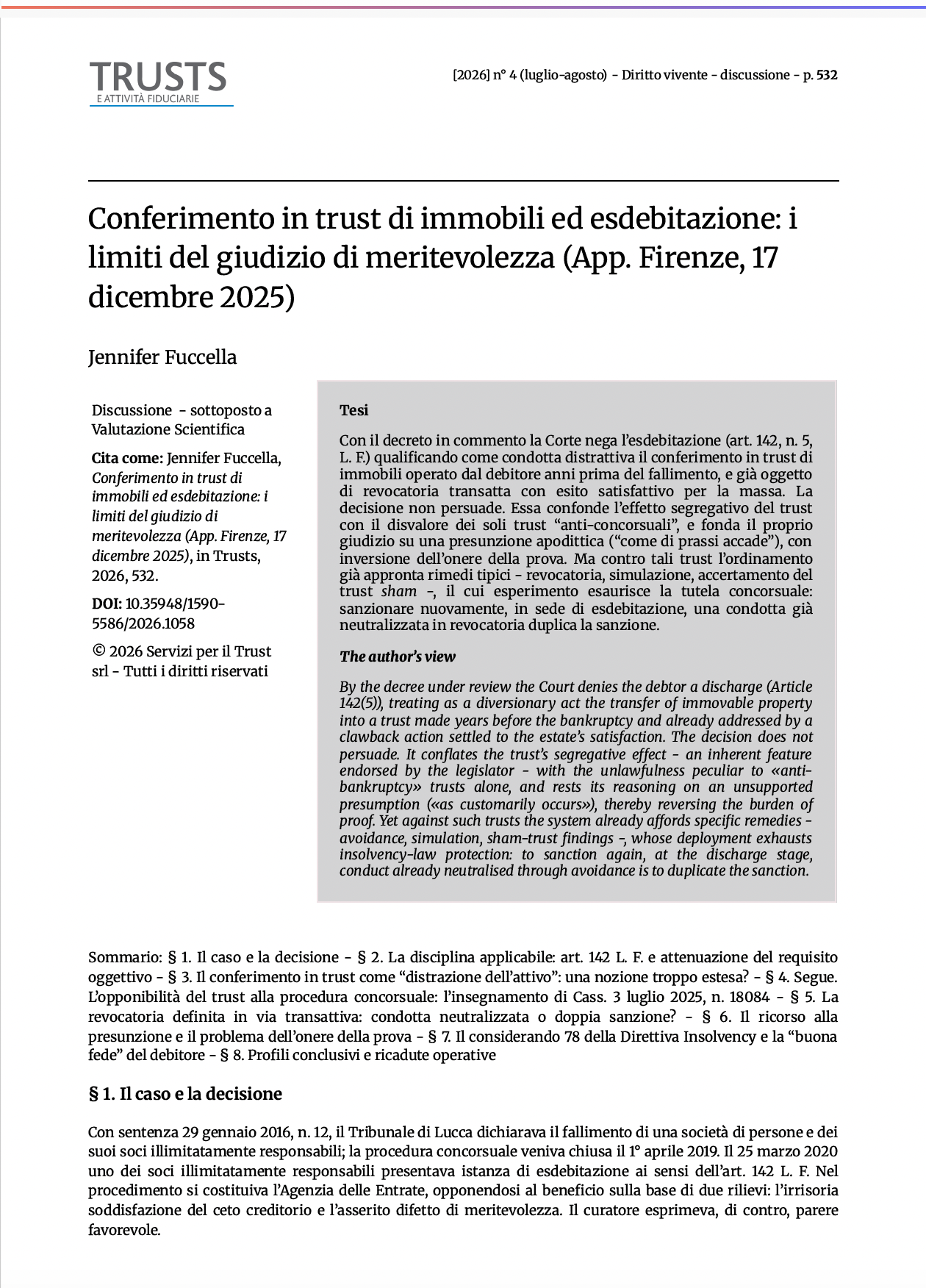
Thesis
In the decree under review, the Court denies discharge from debts (Article 142, no. 5, L. F.), characterising as asset diversion the debtor's transfer of immovable property into a trust years before bankruptcy, which had already been the subject of an avoidance action settled to the satisfaction of the estate. The decision is unpersuasive. It conflates the segregative effect of a trust with the wrongfulness peculiar to "anti-insolvency" trusts, and bases its assessment on an unsupported presumption ("as customarily occurs"), thereby reversing the burden of proof. Yet against such trusts, the legal system already provides specific remedies - avoidance, simulation, a finding that the trust is a sham - whose use exhausts insolvency-law protection: sanctioning again, at the discharge stage, conduct already neutralised through avoidance duplicates the sanction.
The author's view
By the decree under review the Court denies the debtor a discharge (Article 142(5)), treating as a diversionary act the transfer of immovable property into a trust made years before the bankruptcy and already addressed by a clawback action settled to the estate's satisfaction. The decision does not persuade. It conflates the trust's segregative effect - an inherent feature endorsed by the legislator - with the unlawfulness peculiar to «anti-bankruptcy» trusts alone, and rests its reasoning on an unsupported presumption («as customarily occurs»), thereby reversing the burden of proof. Yet against such trusts the system already affords specific remedies - avoidance, simulation, sham-trust findings -, whose deployment exhausts insolvency-law protection: to sanction again, at the discharge stage, conduct already neutralised through avoidance is to duplicate the sanction.
Contents: § 1. The case and the decision - § 2. The applicable rules: Article 142 L. F. and relaxation of the objective requirement - § 3. Transfers into trust as "asset diversion": an overly broad concept? - § 4. Continued. The enforceability of a trust against insolvency proceedings: the guidance from the Italian Supreme Court (Corte di Cassazione), 3 July 2025, no. 18084 - § 5. Avoidance proceedings concluded by settlement: neutralised conduct or a double sanction? - § 6. Reliance on presumptions and the burden of proof - § 7. Recital 78 of the Insolvency Directive and the debtor's "good faith" - § 8. Concluding observations and practical implications
§ 1. The case and the decision
By judgment no. 12 of 29 January 2016, the Lucca Court (Tribunale) declared a partnership and its partners with unlimited liability bankrupt; the insolvency proceedings were closed on 1 April 2019. On 25 March 2020, one of the partners with unlimited liability applied for discharge from debts under Article 142 L. F. The Italian Revenue Agency (Agenzia delle Entrate) appeared in the proceedings, opposing discharge on two grounds: the negligible satisfaction of creditors and the alleged failure to meet the deservingness requirement. The bankruptcy trustee (curatore), by contrast, expressed a favourable opinion.
By decree no. 7428 of 18 September 2025, the Lucca Court (Tribunale) dismissed the application, finding that, before the bankruptcy proceedings commenced, the debtor had transferred two properties he owned into a trust, forcing the bankruptcy trustee to bring avoidance proceedings that were concluded by settlement. The Court (Tribunale) identified this conduct - predating the declaration of bankruptcy - as the basis for the failure to meet the deservingness requirement.
The debtor challenged the decree, arguing that the trust had been established well before the declaration of bankruptcy and that, under the settlement, a sum exceeding the value of his share of the transferred assets had been paid into the estate.
By decree of 15 December 2025, the Florence Court of Appeal dismisses the challenge and upholds the first-instance decision in full. Its reasoning proceeds, in brief, through the following steps: the applicability ratione temporis of the Bankruptcy Law; the diminished significance of the objective requirement that creditors be satisfied at least in part, in the light of Directive (EU) no. 1023 of 20 June 2019 and the most recent Supreme Court case law; the characterisation of the transfer into trust as conduct constituting asset diversion under Article 142, no. 5, L. F.; the relevance of the prolongation of the proceedings attributable to the avoidance action; and the absence of any exonerating effect of the settlement reached in those proceedings.
§ 2. The applicable rules: Article 142 L. F. and relaxation of the objective requirement
As a preliminary matter, the Court clarifies - citing order no. 14835 of 3 June 2025 of the First Division of the Italian Supreme Court (Corte di Cassazione) [1] - that the case is governed by the Bankruptcy Law rather than the Business Crisis and Insolvency Code, since bankruptcy was declared before the CCII entered into force and Article 390 of that Code does not mention discharge proceedings. This clarification, now settled law, is not without significance: the wording of Article 142 L. F. and that of Article 280 CCII do not coincide entirely, and the current rules, in transposing the Insolvency Directive, expressly removed the objective requirement that creditors be satisfied at least in part.
On this point, the Court recalls that, even under the Bankruptcy Law, Supreme Court case law interpreted the provision consistently with the Directive: a debtor cannot be denied discharge solely because of the limited value of their assets, once it has been established that the "lower value" is not the result of obstructive, negligent, fraudulent or asset-diverting conduct; [2] in line with the systematic framework already established by the Joint Divisions (Sezioni Unite) of the Italian Supreme Court (Corte di Cassazione), [3] the reduced significance of the objective element shifts the focus of the assessment to the subjective requirements. Among these, Article 142, no. 5, L. F. excludes discharge for a debtor who "has diverted assets or disclosed non-existent liabilities, caused or aggravated financial collapse by making it seriously difficult to reconstruct the assets and business transactions, or resorted abusively to credit". The Florence Court identifies two distinct situations covered by the provision in the transfer into trust: asset diversion and - albeit not expressly - conduct capable of delaying the proceedings, here taking the form of the need to bring the avoidance action.
§ 3. Transfers into trust as "asset diversion": an overly broad concept?
The core of the decree's reasoning is its characterisation of the transfer into trust as asset diversion. The Court adopts a broad interpretation of the term: diversion, it states, "cannot be understood narrowly as the physical removal of assets, but must be assessed in a broader sense, encompassing any activity aimed at limiting the general pool of assets available to satisfy creditors". Within this framework, the segregative effect of the trust - which isolates the assets from the settlor's estate, placing them beyond the reach of individual enforcement and collective insolvency proceedings - would ex se constitute a ground precluding discharge.
The approach lends itself to a twofold reading. Functionally, it is indisputable that, once the publicity formalities have been completed, a trust produces an asset-separation effect enforceable erga omnes: in that sense, the transfer objectively affects the settlor's general pool of assets available to satisfy creditors. That very characteristic, however, is not a defect but the defining legal feature of the institution, enshrined in the 1985 Hague Convention and now absorbed into the legal system through the recognition of a range of instruments for earmarking assets for particular purposes (family asset funds, purpose restrictions under Article 2645-ter cod. civ., assets earmarked for a specific business undertaking), as well as, specifically in insolvency matters, through references - in legal scholarship and practice - to the use of fiduciary or asset-segregating instruments, including trusts, in over-indebtedness resolution proceedings (Article 7, L. 27 January 2012, no. 3).
Equating trust-based segregation tout court with asset diversion means overlooking the doctrinally decisive distinction between instruments establishing arrangements that earmark assets for legitimate purposes (succession planning, protection of vulnerable persons, organisation of family assets, performance of maintenance obligations) and acts carried out in anticipation of insolvency, and therefore potentially voidable, simulated or, in the common-law terminology, sham. Supreme Court case law has indeed recognised this distinction specifically in insolvency matters: the so-called anti-insolvency trust, "which substitutes itself for bankruptcy proceedings" and "prevents the dispossession of the insolvent business operator", has an actual purpose undeserving of legal protection precisely because it constitutes an "escape" from mandatory insolvency rules; [4] quite different, however, is a trust established while the settlor is solvent and for lawful purposes, whose assessment of deservingness cannot be reduced to a purely formal assessment of its segregative effect. [5]
The most recent Supreme Court criminal case law falls within the same framework: although it recognises that establishing a trust may constitute asset diversion amounting to fraudulent bankruptcy, it makes such a finding conditional on "particularly searching scrutiny by the trial court, examining the transaction as a whole in relation to the actual purpose of the transactional scheme and whether the interests pursued deserve legal protection". In short, it always proceeds from the premise, likewise reiterated by the Italian Supreme Court (Corte di Cassazione), that "establishing a trust constitutes a lawful choice by a business operator" and that a liquidation trust is not prohibited in itself; it is necessary to ascertain in the particular case that "the transaction does not conceal an intention to remove the transferred assets from the previously broader pool of assets available to satisfy creditors". [6]
It follows that the mere production of a segregative effect is insufficient to characterise the act as asset diversion: the trust's actual purpose and the subjective context in which it was established must be investigated. Furthermore, the legal system provides a specific set of remedies against trusts established to the detriment of creditors - an ordinary avoidance action under Article 2901 cod. civ., a bankruptcy avoidance action, a finding of absolute simulation, or characterisation of the trust as ostensible or sham [7] - and, where those remedies are used and produce results satisfying the estate, the very factual premise that would justify treating the transfer as asset-diverting conduct precluding discharge ceases to exist.
§ 4. Continued. The enforceability of a trust against insolvency proceedings: the guidance from the Italian Supreme Court (Corte di Cassazione), 3 July 2025, no. 18084
The approach taken in the Florence decree becomes still more problematic when compared with the principles laid down on the relationship between trusts and insolvency proceedings by the First Division of the Italian Supreme Court (Corte di Cassazione) in judgment no. 18084 of 3 July 2025. Although deciding a different case - a claim by a bankrupt trustee to recover assets that the bankruptcy trustee had inventoried under Article 42 L. F. - the Supreme Court states a general systemic principle: the relationship between a trust and insolvency proceedings is not assessed by reference to the abstract category of "diversion", but on the technical ground of enforceability against creditors, under the mandatory domestic rules which, pursuant to Article 15(d) and (e) of the Hague Convention, preserve the rules on transfers of title and the protection of creditors in matters of insolvency. [8]
The principle is expressed clearly: a trust "is not an entity with legal personality", but "a collection of assets and legal relationships, earmarked for a specific purpose and formally vested in the trustee", and the trustee's acquisition is "merely the functional means of achieving the subsequent final effect"; in the absence of registration of the disposition before bankruptcy (Article 45 L. F.) or, for movable assets, a legally certain date preceding the commencement of collective proceedings (Article 2704 cod. civ.), the trust is not enforceable against the bankruptcy trustee. Moreover, the same judgment anchors the response to potentially prejudicial transfers in two distinct, specific areas - an assessment intended to "examine the actual purpose of the trust's transactional scheme and whether the associated interests deserve legal protection", and the application of recovery remedies, "such as ordinary or bankruptcy avoidance actions" - without ever elevating the segregative effect itself into an independent category of asset diversion: the assessment of deservingness therefore requires a concrete analysis of the act, rather than a presumption about it. [9]
Applying this systemic framework to the case decided by the Florence Court of Appeal reveals a methodological inconsistency of considerable significance. In this case, the issue of the trust's enforceability against the bankrupt settlor's creditors had already been addressed - and resolved - in its proper forum: the bankruptcy trustee had brought an avoidance action and, through the settlement, had pursued the restoration of the asset balance afforded by mandatory insolvency rules. Subsequently holding the same conduct against the debtor again - no longer in terms of unenforceability, an issue already addressed through recovery remedies in those proceedings, but as "asset diversion" for the purposes of Article 142 L. F. - means removing it from the analytical framework assigned to it by the most recent Supreme Court case law and relocating it, solely for punitive purposes, to a doctrinally different plane where its financial effects have already been exhausted. As will be seen below, this observation is not without significance in terms of proportionality.
§ 5. Avoidance proceedings concluded by settlement: neutralised conduct or a double sanction?
The way in which the Court treats the settlement reached in the avoidance proceedings brought by the bankruptcy trustee merits particular attention. The debtor challenging the decree had argued that he had paid the estate a sum exceeding the value of his share of the immovable property transferred. The Court dismisses the argument with reasoning worth quoting: the settlement, it states, "at most reduced the negative effects of his conduct, and in any event was compelled by the fact that the outcome of the proceedings appeared a foregone conclusion in the light of settled case law, also considering that it nevertheless ensured the retention of title to the assets transferred into the trust".
Although effective within the logic of the decision, this reasoning leaves significant questions unanswered. Doctrinally, it appears to overlook the distinction between assessing conduct - which concerns the past - and assessing the current position of creditors' interests - which concerns the present. If the ultimate purpose of the deservingness assessment is to protect the estate, and if the estate has obtained through settlement the restoration of the asset balance that the avoidance action would have pursued through a judicial determination and restitution, the original conduct loses - at least to a large extent - its objective wrongfulness. The disqualifying condition in Article 142, no. 5, L. F. does not, after all, serve a punitive function, but safeguards the assets available to satisfy creditors: once the prejudice has been fully removed through the specific remedies provided, the wrongfulness targeted by the provision ceases to exist, so that holding the same conduct against the debtor again ultimately takes on a purely punitive character, alien to the rationale of the deservingness filter. Maintaining that the settlement "at most reduced the negative effects" presupposes residual negative effects, but the decree does not identify them: in particular, it does not analyse the relationship between the value of the assets and the sum paid, and indeed expressly states that the value of the properties "cannot be inferred uncritically from the instrument transferring them into the trust".
From another perspective, the observation that the settlement was supposedly "compelled" by the foreseeable outcome of the proceedings is not decisive: the near certainty of an adverse judgment does not deprive the settlement of its value in satisfying the estate; on the contrary, it accelerates its effects, reducing the costs and time required for recovery. Nor is the argument that the debtor "retained title to the assets transferred into the trust" persuasive: that circumstance concerns the parties' choice not to dissolve the trust but to compensate for its effects in monetary terms, and is in itself neutral for the deservingness assessment. Indeed, in the paradigmatic cases in which the courts characterise a trust as a means of prejudicing creditors, the typical outcome of avoidance proceedings is a declaration that the transfer is ineffective as against the estate, with the result that the asset becomes subject to enforcement or insolvency proceedings; [10] a settlement accompanied by payment of an equivalent sum represents a financially equivalent but procedurally more efficient solution, and should not be treated less favourably than a judgment allowing the action for the purposes of assessing deservingness.
It is, however, necessary to distinguish the issue of asset diversion (Article 142, no. 5, L. F.), to which the preceding observations relate, from the separate prohibition on having "in any way delayed or contributed to delaying" the conduct of the proceedings (Article 142, no. 2, L. F.), to which the Court refers, albeit not expressly, in the form of the need to bring the avoidance action. The financial compensation obtained through settlement concerns the first issue and does not, in itself, dispose of the second. Nevertheless, the point appears to have limited scope in this case: the transfer predates the declaration of bankruptcy and therefore does not affect the "conduct" of proceedings not yet pending; moreover, the prolongation attributable to the avoidance action is the ordinary consequence of the bankruptcy trustee's use of a specific remedy against a prejudicial act - a consequence which the settlement helped to mitigate by reducing recovery costs and times. Treating the mere need to bring an avoidance action as constituting, ex se, an independent ground precluding discharge under no. 2 would ultimately turn the very existence of a voidable act into a ground for denying discharge, thereby depriving the provision of its selective function.
The doubt therefore remains that the decree in practice duplicates the sanction: if the settlement fully compensated for the financial prejudice, the conduct must be regarded as already neutralised in financial terms through the avoidance action and settlement, and its use a second time to bar discharge potentially conflicts with an implicit principle of proportionality that should govern the assessment of the subjective requirements under Article 142 L. F. Far from being merely implicit, that principle of proportionality rests on the requirement of reasonableness under Article 3 of the Constitution and on the very objective of a "second chance" pursued by Directive (EU) 2019/1023, which preclude restricting access to discharge beyond what is necessary to protect creditors already otherwise satisfied.
§ 6. Reliance on presumptions and the burden of proof
Perhaps the most delicate passage in the decree's reasoning is where the Court addresses the purpose underlying the transfer into trust. It states: "In the present case, although there are no objective data by reference to which the time when the partnership became insolvent can be established, since no alternative justifications are provided, it may be presumed that, as customarily occurs, the creation of the trust was intended precisely to create a restriction on the availability of the assets enforceable against creditors".
The statement is twofold. First, the Court acknowledges that it has no objective data on when insolvency arose - a circumstance which, in analogous cases, is decisive, since only temporal proximity between the trust and financial distress justifies a presumption of a defensive purpose. Secondly, in the absence of such data, the Court resorts to a double presumption: "practice" - according to which trusts are "normally" established for defensive purposes - and the debtor's silence - in that he had not "provided alternative justifications".
Both steps give rise to reservations. The reference to "practice", in the absence of an empirical study of Italian cases, is an essentially intuitive argument, and ultimately reproduces a pre-formed value judgment about the institution within the judicial reasoning. In the Italian legal system, trusts are now frequently used for succession planning, protecting vulnerable persons, organising family assets, securing commercial transactions and segregating assets earmarked for professional activities. The presumption has no stated statistical basis and may have a prejudicial effect on legitimate uses of the institution.
The second step raises an issue concerning the allocation of the burden of proof. Placing the burden on the debtor to provide an "alternative justification" against a presumption of defensive purpose means reversing the normal allocation of that burden. If the party opposing discharge alleges asset-diverting conduct, it seems reasonable to require that party to provide indicators capable of supporting the allegation: such indicators exist and are well established in legal scholarship and tax and civil case law. Examples include temporal proximity between the trust and financial distress (decisive in the case concerning a doctor decided by the Lecce Court (Tribunale), where the trust was established shortly before or after allegations of professional wrongdoing); the settlor, trustee and beneficiaries being the same persons; the reservation of powers to appoint and remove the trustee, protector and beneficiaries and to alter the trust's purpose (indicators relied on by the Vicenza Court (Tribunale) in relation to a family trust used to remove assets from creditors' reach [11]); the disproportion between the assets transferred and those remaining; and the settlor's continued de facto management. Indeed, in the field of financial distress resolution itself, a trust established when a financial imbalance had already crystallised, with provisions designed to preserve the settlor's control over the assets, has been held to constitute a fraudulent act precluding relief. [12] Tax case law - summarised in this Journal [13] - offers a detailed catalogue of "factual elements" that can also be used in insolvency proceedings. Legal scholarship on ostensible discretionary trusts and sham trusts [14] provides similar assistance and is now sufficiently refined to avoid reliance on indiscriminate presumptions.
In the absence of such indicators, analysis of the trust instrument - the transactional scheme, the identity of the beneficiaries and the actual purpose - becomes indispensable. The decree says nothing on these matters: we do not know whether the trust had beneficiaries other than the settlor, whether there was a protector, whether its structure provided mechanisms to protect the beneficiaries, or whether the settlor had reserved powers capable of undermining its genuineness. These are the elements that define the boundary between a recognised trust and a simulated or ostensible trust.
§ 7. Recital 78 of the Insolvency Directive and the debtor's "good faith"
The Court devotes a specific passage to recital 78 of Directive (EU) 2019/1023, which refers to the "dishonest and bad-faith" entrepreneur. The decision states that the concept should not be understood "in a moral sense, but in the broader sense of conduct not guided by good faith towards creditors, which also includes attempts to remove assets from the reach of enforcement by them".
This interpretation is, in itself, sound: the Directive does not make discharge conditional on a moral judgment of the debtor, but on a relational assessment of the quality of their conduct towards creditors. However, applying the concept in practice cannot dispense with respect for the principle of culpability, albeit in an attenuated form, which permeates the disqualifying conditions in Article 142 L. F. Deliberately defensive conduct occurring close in time to insolvency is one thing; the segregative effect of an act carried out, perhaps years earlier, for legitimate purposes and subsequently overtaken by financial distress is another. Nor should it be overlooked that the legislature in 2019, in transposing the Directive, raised the threshold for access to discharge to facilitate the entrepreneur's "second chance" - an approach shared beyond national borders, as illustrated by the comparative analysis of the San Marino experience recently proposed in this Journal. [15]
The point is linked to the scope of the concept of "good faith" in insolvency matters. An overly elastic concept risks making discharge a benefit to which access is intermittent, subject to case-specific assessments that are difficult to predict; an overly narrow concept betrays the protective purpose that the Directive sought to strengthen. The balance lies in giving weight to case-by-case analysis based on objective elements: timing, the structure of the instrument, the identity of the persons involved and the outcome of avoidance proceedings. Reliance on general presumptions - whether of "practice" or "purpose" - appears difficult to reconcile with that approach.
§ 8. Concluding observations and practical implications
The decree forms part of a line of case law tending to take a strict approach to asset planning before financial collapse. The rigidity of the outcome is probably consistent with the particular circumstances of the case, not all of which are disclosed in the decree, although it suggests some connection between the establishment of the trust and the subsequent financial collapse. The methodological caution nevertheless remains: presuming a trust's defensive purpose without examining the trust instrument, and treating the settlement of avoidance proceedings as at most a mitigating rather than a neutralising factor, are approaches to reasoning which, if generalised, risk undermining the institution's functionality.
In practical terms, the decision reinforces several points relevant to advisory practice. First, documentation contemporaneous with the establishment of the trust becomes decisive: documentary evidence of its purposes (succession planning, protection of vulnerable persons, security for third parties) and a record of the settlor's economic and financial position at the time of establishment are elements on which, in litigation, the "alternative justification" may be based, the absence of which the Court used as presumptive evidence against the debtor.
Secondly, temporal proximity between the establishment of the trust and financial distress is the decisive risk factor - more so than the segregative effect: trusts established at a time free from suspicion, with beneficiaries distinct from the settlor and independent governance (a professional trustee, a protector and replacement mechanisms), are less exposed to the recharacterisation adopted in the decree. Thirdly, the outcome of avoidance proceedings - whether by judicial determination or settlement - should be given weight not merely as an element in calculating residual loss, but as a fact capable of "cleansing" the conduct of a further adverse assessment for discharge purposes. A Supreme Court ruling identifying clearer criteria governing the interaction between concluded avoidance proceedings and the deservingness requirement would be desirable.
Finally, from a de iure condendo perspective, the analysis extends to the relationship between Article 142 L. F. and Article 280 CCII. The latter, having removed the objective requirement, retained the subjective requirements, substantially reproducing the catalogue in the previous rules. The case law that develops under the new regime will therefore inherit the analyses developed under the Bankruptcy Law; indeed, more discerning insolvency scholarship has already warned of the risk that the deservingness assessment may become a formalistic review of the chosen legal form, rather than focusing on the fundamental principles of insolvency law (early identification of financial distress, better satisfaction of creditors and treatment no less favourable than in judicial liquidation). [16] For this reason, characterising a trust as an instrument that is "inherently" asset-diverting - or, conversely, as an instrument that is "inherently" legitimate unless proved otherwise - is not an issue confined to the previous legal framework, but extends to the practical application of the Business Crisis Code itself. Once again, the balance lies in giving weight to analysis of the trust instrument: effective protection of the "honest" debtor - and, correspondingly, an effective response to the debtor acting "in bad faith" - cannot be constructed through general presumptions, but must rest on a concrete analysis of the transactional scheme and the circumstances in which it was implemented.
Notes
- Italian Supreme Court (Corte di Cassazione), order no. 14835 of 3 June 2025, according to which "in matters of discharge, an application submitted after the entry into force of the Business Crisis and Insolvency Code (15 July 2022) by a person declared bankrupt before that date remains governed by the Bankruptcy Law", since Article 390 CCII does not mention discharge proceedings.
- Italian Supreme Court (Corte di Cassazione), Civil Division, 6 November 2024, no. 28505, according to which "a debtor cannot be denied discharge under Article 142 L. F. because of the limited value of their assets, once it has in any event been ruled out that the lower value results from any obstructive, negligent, fraudulent, asset-diverting or otherwise criminally relevant conduct on their part".
- Italian Supreme Court (Corte di Cassazione), Joint Divisions (Sezioni Unite), 18 November 2011, no. 24214, on the systematic framework of discharge under Article 142 L. F.
- Italian Supreme Court (Corte di Cassazione), Civil Division, 9 May 2014, no. 10105, in Corr. giur., 2015, II, 192, according to which a trust that "substitutes itself for bankruptcy proceedings" and "prevents the dispossession of the insolvent business operator (a so-called anti-insolvency or falsely liquidating trust)" has an actual purpose undeserving of legal protection and, being incapable of recognition in the legal system, is wholly ineffective. For a systematic account of the debate and the evolution of the deservingness assessment in the light of the CCII, A. Mariani, Liquidation trusts and the Business Crisis and Insolvency Code, in this Journal, 2025, 367. On the criminal-law relevance of sham trusts, F. Mazzacuva, Sham trusts and criminal law, ibid., 2026, 31.
- Italian Supreme Court (Corte di Cassazione), Civil Division, 10 February 2020, no. 3128, in Società, 2020, X, 1089, which identifies the criterion for recognising a liquidation trust as examination of its actual purpose and the interests pursued, to be conducted within the limits imposed by the Bankruptcy Law and the system of avoidance actions. To the same effect, most recently, A. Mariani, Liquidation trusts and the Business Crisis Code, cited above, especially 369, identifying the criteria for assessing deservingness in the principles of early identification of financial distress and treatment no less favourable.
- Italian Supreme Court (Corte di Cassazione), Criminal Division, 20 May 2024, no. 19973, on which see G. Francolini, Trusts and fraudulent bankruptcy involving assets: observations on Italian Supreme Court (Corte di Cassazione), Criminal Division, 20 May 2024, no. 19973, in this Journal, 2025, 643.
- For the approach favouring the availability of avoidance actions against the instrument establishing the trust itself (and not merely the instrument endowing it with assets), L. Galanti, Avoidance of the trust instrument and the "derivative" ineffectiveness of the disposition (Foggia Court (Tribunale), 20 May 2024), in this Journal, 2025, 114; G.M. Marsico, The market and creditor protection (Rome Court of Appeal, 7 November 2024), ibid., 2025, 304; F. Costantini, Self-declared trusts and avoidance actions (Salerno Court (Tribunale), 1 October 2025), ibid., 2026, 192; G. Bazzoni, The voidability of family trusts prejudicial to creditors (Modena Court (Tribunale), 26 March 2025), ibid., 2026, 182. On standing to be sued, E. Hepaj, Avoidance actions involving trusts (Cosenza Court (Tribunale), 7 October 2024), ibid., 2025, 623. On the analogous issue of purpose restrictions under Article 2645-ter cod. civ., decided by the same Florence Court of Appeal consistently with the decree under review, A.M. Borgna, Purpose restrictions and the application of the protection under Article 2901 cod. civ. (Florence Court of Appeal, 11 September 2024), ibid., 2025, 43.
- In line with this approach, but with specific reference to the distinct issue of jurisdiction, Italian Supreme Court (Corte di Cassazione), Joint Divisions (Sezioni Unite), 1 October 2025, no. 26471, on which see M. Lupoi, Questions of jurisdiction and applicable law in a recent decision of the Joint Civil Divisions (Sezioni Unite) (Italian Supreme Court (Corte di Cassazione), 1 October 2025, no. 26471), in this Journal, 2026, 114, critically observing that the order does not distinguish sufficiently between applicable law and the assertion of jurisdiction.
- Italian Supreme Court (Corte di Cassazione), 3 July 2025, no. 18084, cited above, §§ 2.8–2.9 of the reasoning, referring to Italian Supreme Court (Corte di Cassazione), 10 February 2020, no. 3128.
- For an illustrative case of a trust established by a doctor close in time to allegations of professional wrongdoing and subject to an ordinary avoidance action, see A. Capicchioni, Avoidance action against the placement of all a doctor's assets in trust following surgery (Lecce Court (Tribunale), 22 May 2024), in this Journal, 2025, 48: in allowing the claim, the Court (Tribunale) gives weight to the chronological sequence of the harmful event, the request for medical records and the establishment of the trust, as well as the fact that, contrary to its stated purposes, the fund had remained entirely at the settlor's disposal.
- E. Adilardi, Family trusts and avoidance actions (Vicenza Court (Tribunale), 4 March 2025), in this Journal, 2025, 556, on the decision according to which "the reservation to the settlor of a family trust of the power to replace at will the trustee, the beneficiaries and the protector, as well as to change the trust's purpose, creates an arrangement which clearly reveals the instrumental use of the transfer of assets into trust to the detriment of creditors, since the settlor remains, in substance, fully in control of those assets".
- P. Zagami, Italian rules on over-indebtedness between international best practices and trusts, in this Journal, 2015, 556.
- V. Masotti, Fictitious trusts in Italian Revenue Agency (Agenzia delle Entrate) assessments: an examination of factual elements through an analysis of judgments, in this Journal, 2025, 551, which, drawing on tax court case law, reconstructs the indicators of so-called fictitiousness: absence of genuine asset separation, identity between settlor and beneficiary, retention of management powers by the settlor, changes to beneficiaries, trustee or protector during the life of the trust, and a discrepancy between the stated purpose and the value of the transfer.
- M. Lupoi, Discretionary powers and ostensible discretionary trusts, in this Journal, 2025, 204, on trusts in which the trustee's discretion is emptied of substance by the settlor's predominance, resulting in nullity because the institution's defining features are absent. On the role of sham trusts in criminal proceedings and the indicators developed in case law - many overlapping with those relevant in civil proceedings - F. Mazzacuva, Sham trusts and criminal law, ibid., 2026, 31, especially §§ 3–4. On the civil-law side, A.M. Borgna, On an alternative claim alleging simulation of a trust holding company interests, in this Journal, 2025, 561.
- F. Giovagnoli, San Marino trusts, between financial distress and insolvency: the response of a non-codified legal system, in this Journal, 2025, 541, offering a comparative reading of the use of trusts in situations of financial distress and insolvency, stressing the need for a case-by-case assessment of the transaction's actual purpose and recalling the impetus towards harmonisation provided by Directive (EU) 2019/1023.
- For a detailed discussion, see A. Mariani, Liquidation trusts and the Business Crisis and Insolvency Code, cited above, especially 372, identifying as criteria for assessing whether a liquidation trust outside insolvency proceedings deserves legal protection the principles of early identification of financial distress (Articles 2086, paragraph 2, cod. civ. and 3 CCII) and better satisfaction of creditors, to be implemented also by extending the principle of treatment no less favourable beyond the scope of the specific statutory instruments for resolving financial distress.
Frequently Asked Questions
Does transferring immovable property into a trust always prevent discharge from debts?
No. According to the critical interpretation proposed, the mere production of a segregative effect is insufficient to characterise the act as asset diversion under Article 142, no. 5, L. F.: the trust's actual purpose and the subjective context in which it was established must be investigated.
What did the Florence Court of Appeal decide?
By decree of 15 December 2025, the Court dismissed the challenge and upheld the refusal of discharge, characterising the transfer into trust as asset diversion and considering the prolongation of the proceedings attributable to the avoidance action to be relevant.
Does a settlement reached in avoidance proceedings neutralise the conduct?
For the Court, the settlement "at most reduced the negative effects" of the conduct. In the analysis presented, however, if the settlement fully compensated for the financial prejudice, the conduct must be regarded as already neutralised, and its reuse to bar discharge conflicts with a principle of proportionality.
What indicators suggest that a trust was established to the detriment of creditors?
Temporal proximity between the trust and financial distress; the settlor, trustee and beneficiaries being the same persons; the reservation of powers to appoint and remove the trustee, protector and beneficiaries and to alter the purpose; disproportion between the assets transferred and those remaining; and the settlor's continued de facto management.
What practical guidance follows for those establishing a trust?
Document the purposes contemporaneously with establishment (succession planning, protection of vulnerable persons, security for third parties), establish the trust at a time free from suspicion, and provide for beneficiaries distinct from the settlor and independent governance (a professional trustee, a protector and replacement mechanisms).