
Key Points
- A corporate income tax (IRES) credit claimed as a refund in the consolidated tax return cannot change course: an amended return cannot be used to reclassify its allocation as an intra-group transfer under art. 43-ter of dpr n. 602/1973.
- A return may be amended only to correct errors or omissions: as regards the allocation of the surplus, the only permitted change is from a refund to offsetting, within one hundred and twenty days of the expiry of the ordinary filing deadline.
- This was clarified by the Italian Revenue Agency (Agenzia delle Entrate) in tax ruling (risposta a interpello) no. 147 of 16 July 2026, rejecting the proposal of a consolidating company seeking to transfer to itself a residual surplus of over EUR 1.2 million, and then use it for offsetting.
- The negative outcome on the first question renders the other two moot: no position was taken on the implied repeal of paragraph 8-ter of art. 2 of dpr n. 322/1998, or on the limits on the transferee's use of the credit.
Corporate income tax (IRES) credit, a prescribed route
A corporate income tax (IRES) credit claimed as a refund in the consolidated tax return cannot change course: an amended return cannot be used to reclassify its allocation as an intra-group transfer under art. 43-ter of dpr n. 602/1973.
A return may therefore be amended only to correct errors or omissions. As regards the allocation of the surplus, the only permitted change is from a refund to offsetting, within one hundred and twenty days of the expiry of the ordinary filing deadline.
This was clarified by the Italian Revenue Agency (Agenzia delle Entrate) in tax ruling (risposta a interpello) no. 147 of 16 July 2026, rejecting the proposal of a consolidating company seeking to transfer to itself a residual surplus of over EUR 1.2 million, and then use it for offsetting. The negative outcome on the first question also renders the other two moot: no position was therefore taken on the implied repeal of paragraph 8-ter of art. 2 of dpr n. 322/1998, or on the limits on the transferee's use of the credit.
The case
On 31 October 2024, the consolidating company of a tax group filed the "National and Worldwide Tax Consolidation 2024" return for the 2023 tax period, showing a corporate income tax (IRES) surplus credit of EUR 2,729,533, entered in line CN24 as an available credit and allocated to offsetting. This was followed on 3 December 2024 by an amended return ("more precisely, a late return", as the ruling notes) in which, by completing line CN22, a transfer of EUR 1.5 million under art. 43-ter was reported, while the remaining EUR 1,229,533 was allocated to a refund. Accordingly, the credit was not carried forward in the CNM 2025 return for the 2024 tax period, filed on 29 January 2026.
Hence the two-step process proposed in the request: a second amended CNM 2024 return to move the balance from line CN24 (refund) to line CN22 (transferred credit), in favour of the consolidating company itself; and an amended Redditi SC 2023 return for that company to record the credit in section III ("Credits received") of schedule RK and use it for offsetting, including against liabilities from previous financial years.
When an amended return is admissible
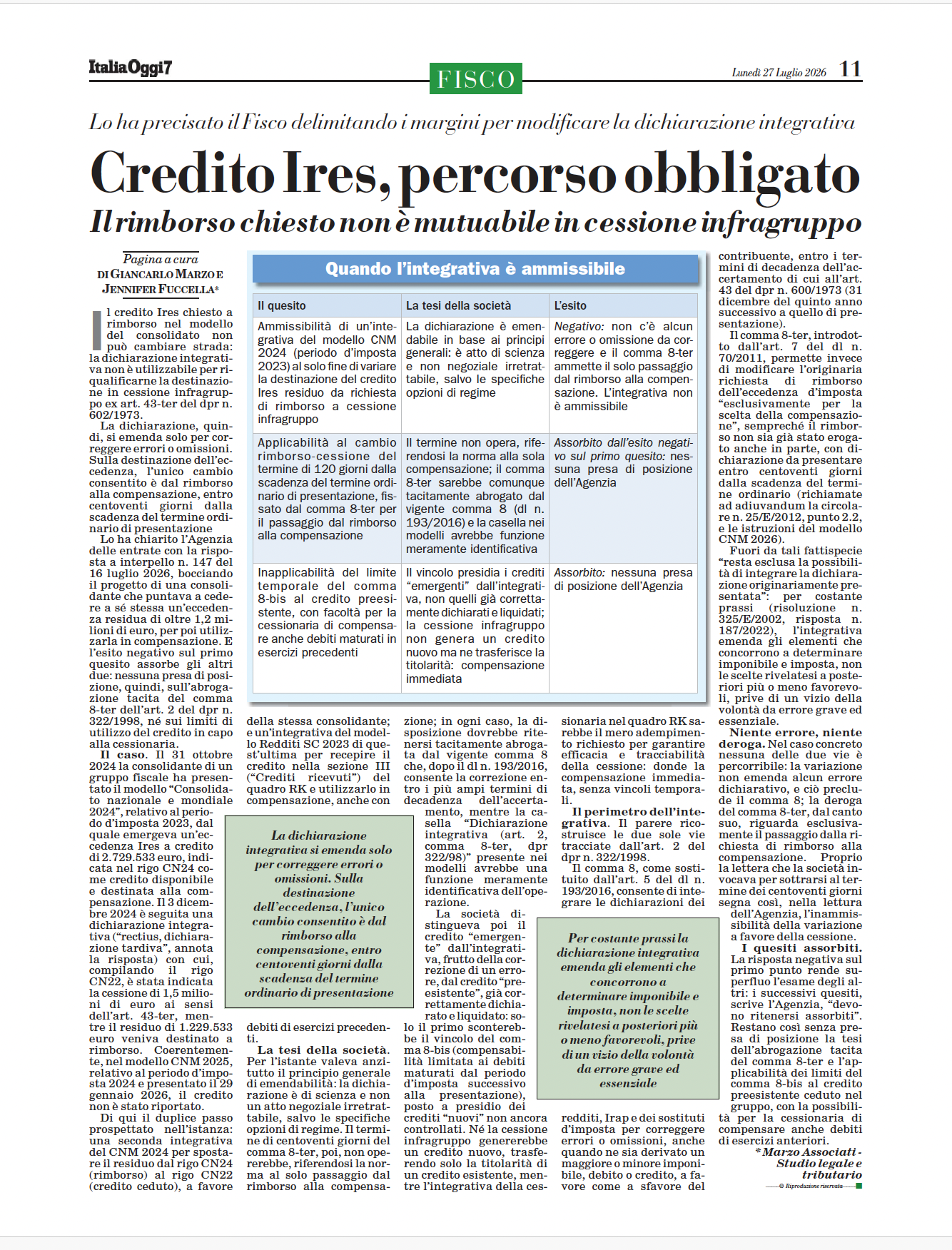
| The question | The company's argument | The outcome |
| --- | --- | --- |
| Admissibility of an amended CNM 2024 return (2023 tax period) solely to change the allocation of the residual corporate income tax (IRES) credit from a refund claim to an intra-group transfer | The return may be amended under general principles: it is a statement of knowledge, not an irrevocable act of legal disposition, except for specific tax regime elections | Negative: there is no error or omission to correct, and paragraph 8-ter permits only a change from a refund to offsetting. The amended return is inadmissible |
| Applicability to the change from a refund to a transfer of the deadline of 120 days from the expiry of the ordinary filing deadline, laid down by paragraph 8-ter for a change from a refund to offsetting | The deadline does not apply, as the provision refers only to offsetting; paragraph 8-ter has, in any event, allegedly been impliedly repealed by the current paragraph 8 (dl n. 193/2016), and the box in the forms serves merely to identify the transaction | Rendered moot by the negative outcome on the first question: no position taken by the Agency |
| Inapplicability of the time restriction under paragraph 8-bis to the pre-existing credit, allowing the transferee also to offset liabilities accrued in previous financial years | The restriction safeguards credits "arising" from the amended return, not those already correctly declared and calculated; an intra-group transfer does not generate a new credit but transfers ownership of it: immediate offsetting | Rendered moot: no position taken by the Agency |
The company's argument
The applicant relied first on the general principle that returns may be amended: a return is a statement of knowledge, not an irrevocable act of legal disposition, except for specific tax regime elections. Furthermore, the one-hundred-and-twenty-day deadline under paragraph 8-ter would not apply, as the provision refers only to a change from a refund to offsetting; in any event, the provision should be regarded as impliedly repealed by the current paragraph 8 which, following dl n. 193/2016, allows corrections within the longer statutory time limits for assessment, while the box "Amended return (art. 2, paragraph 8-ter, dpr 322/98)" in the forms merely serves to identify the transaction.
The company then distinguished between a credit "arising" from an amended return as a result of correcting an error and a "pre-existing" credit, already correctly declared and calculated: only the former would be subject to the restriction under paragraph 8-bis (offsetting limited to liabilities accrued from the tax period following filing), which safeguards "new" credits not yet checked. Nor would an intra-group transfer generate a new credit, since it merely transfers ownership of an existing credit, while the transferee's amendment to schedule RK would be the mere formality required to ensure the effectiveness and traceability of the transfer: hence immediate offsetting, without time restrictions.
The scope of an amended return
The opinion sets out the only two routes provided by art. 2 of dpr n. 322/1998. Paragraph 8, as replaced by art. 5 of dl n. 193/2016, allows income tax, regional tax on productive activities (IRAP) and withholding agents' returns to be amended to correct errors or omissions, including where these have resulted in a higher or lower taxable amount, liability or credit, whether in the taxpayer's favour or otherwise, within the statutory time limits for assessment under art. 43 of dpr n. 600/1973 (31 December of the fifth year following the year of filing).
Paragraph 8-ter, introduced by art. 7 of dl n. 70/2011, instead permits the original claim for a refund of the tax surplus to be changed "exclusively to elect offsetting", provided that the refund has not already been paid, even in part, by filing a return within one hundred and twenty days of the expiry of the ordinary deadline (circular no. 25/E/2012, point 2.2, and the instructions for the CNM 2026 form are cited in support).
Outside these circumstances, "the possibility of amending the return originally filed remains excluded": under established administrative practice (resolution no. 325/E/2002, ruling no. 187/2022), an amended return corrects the elements contributing to the determination of the taxable amount and tax, not choices that have proved more or less favourable in hindsight and are not vitiated by a serious and fundamental error affecting consent.
No error, no exception
In the case at hand, neither route is available: the change does not correct any error in the return, which rules out paragraph 8; the exception under paragraph 8-ter, for its part, concerns exclusively a change from a refund claim to offsetting. Thus, in the Agency's interpretation, the very wording on which the company relied to avoid the one-hundred-and-twenty-day deadline establishes the inadmissibility of a change to a transfer.
The questions rendered moot
The negative answer on the first point makes it unnecessary to examine the others: the subsequent questions, the Agency writes, "must be regarded as moot". No position was therefore taken on the argument that paragraph 8-ter had been impliedly repealed or on the applicability of the restrictions under paragraph 8-bis to the pre-existing credit transferred within the group, with the possibility for the transferee also to offset liabilities from earlier financial years.
Article published in ItaliaOggi7 on 27 July 2026, by Giancarlo Marzo — Marzo Associati, law and tax firm.
Frequently Asked Questions
Can a corporate income tax (IRES) credit claimed as a refund be converted into an intra-group transfer through an amended return?
No. According to tax ruling (risposta a interpello) no. 147 of 16 July 2026, an amended return cannot be used to reclassify the allocation of a corporate income tax (IRES) credit from a refund claim to an intra-group transfer under art. 43-ter of dpr n. 602/1973.
What change in the allocation of the surplus is permitted?
As regards the allocation of the surplus, the only permitted change is from a refund to offsetting, within one hundred and twenty days of the expiry of the ordinary filing deadline, provided that the refund has not already been paid, even in part (art. 2, paragraph 8-ter, dpr n. 322/1998).
What time limits apply to an "ordinary" amended return?
Paragraph 8 of art. 2 of dpr n. 322/1998, as replaced by art. 5 of dl n. 193/2016, allows errors or omissions to be corrected within the statutory time limits for assessment under art. 43 of dpr n. 600/1973, namely 31 December of the fifth year following the year of filing.
Why was the amended return considered inadmissible in the case examined?
Because the change did not correct any error in the return — which rules out paragraph 8 — and because the exception under paragraph 8-ter concerns exclusively a change from a refund claim to offsetting.
Did the Agency express a view on the implied repeal of paragraph 8-ter and the restrictions under paragraph 8-bis?
No. The negative answer to the first question made it unnecessary to examine the others: the subsequent questions, the Agency writes, "must be regarded as moot".


