Back to Articles
    Legislative Updates22 December 20253 min
    Photo of the author, Giancarlo Marzo, tax lawyer in RomeAvv. Giancarlo Marzo — Tax Lawyer, FounderProfile

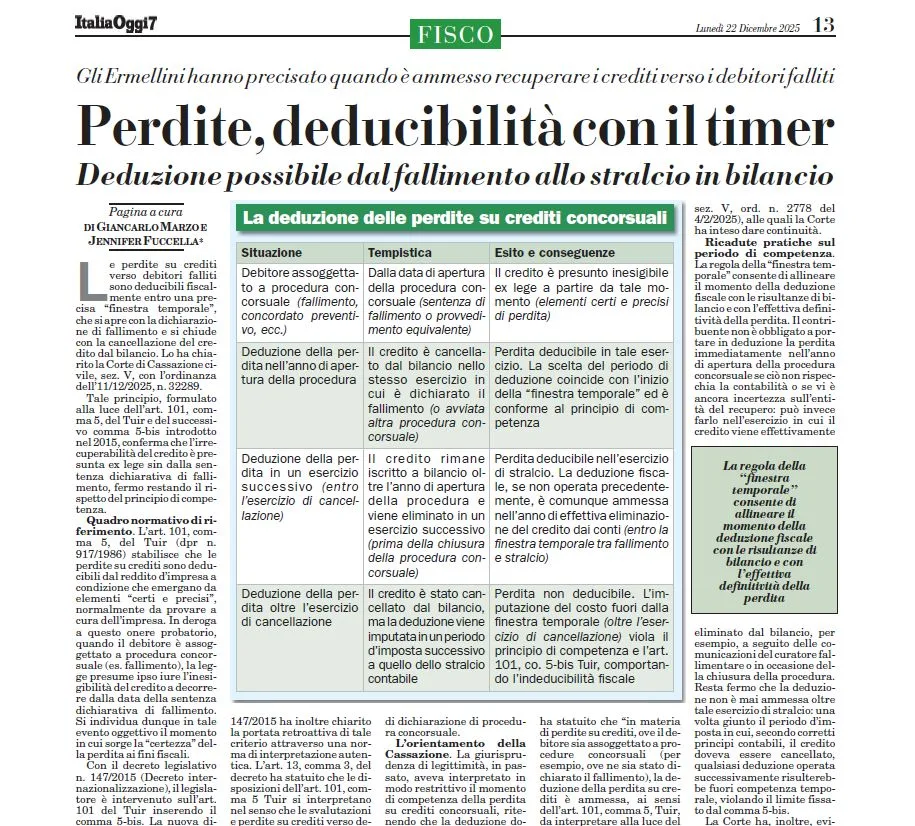
    Losses on debts in insolvency proceedings: the Italian Supreme Court (Corte di Cassazione) sets the "time window" for deductibility

    The Italian Supreme Court (Corte di Cassazione) establishes precise **time windows** for the **deductibility of losses on debts in insolvency proceedings**, between the opening of proceedings and write-off.

    Featured image: Losses on debts in insolvency proceedings: the Italian Supreme Court (Corte di Cassazione) sets the "time window" for deductibility

    Introduction: The Italian Supreme Court (Corte di Cassazione) defines the "time window" for the deductibility of losses on debts in insolvency proceedings

    The correct recognition in profit or loss of losses on debts owed by parties subject to insolvency proceedings received fundamental clarification in Order No. 32289 of the Italian Supreme Court (Corte di Cassazione) of 11 December 2025. This ruling establishes the time limits for the deductibility of such losses from business income.

    Deductibility of losses on debts owed by bankrupt debtors: Time limits and the accruals principle

    The Italian Supreme Court (Corte di Cassazione) has established that losses on debts owed by bankrupt debtors are deductible from business income only within a specific "time window". Under Article 101, paragraphs 5 and 5-bis of the Italian Income Tax Code (TUIR), the irrecoverability of the debt is presumed ex lege from the date of the judgment declaring bankruptcy (or an equivalent order).

    The limits of deductibility

    The period for claiming the deduction is not unlimited and is defined as follows:
    • Opening of the window: This coincides with the financial year in which the opening of insolvency proceedings is declared. The "certain and precise" elements required by the provision for deductibility arise in that financial year.
    • Closing of the window: This corresponds to the financial year in which the receivable is definitively derecognised and written off from the balance sheet.


    Compliance with the accruals principle

    The Italian Supreme Court (Corte di Cassazione) emphasised that the taxpayer is not strictly required to deduct the loss in the year in which proceedings are opened if uncertainty remains as to the amount of any recovery. The deduction may be deferred to a subsequent financial year, provided that it is claimed no later than the year in which the receivable is actually derecognised in the accounts. Any deduction claimed in financial years subsequent to derecognition from the balance sheet falls outside the appropriate accounting period, making the loss non-deductible for tax purposes.

    Conclusions

    Order No. 32289 of 2025 of the Italian Supreme Court (Corte di Cassazione) provides a clear framework for the time limits governing the deductibility of losses on debts in insolvency proceedings, emphasising the importance of the accruals principle and the correct accounting and tax treatment of these items.

    Frequently Asked Questions

    What is the "time window" for the deductibility of losses on debts in insolvency proceedings?

    The time window opens with the financial year in which the opening of insolvency proceedings is declared and closes with the financial year in which the receivable is definitively derecognised and written off from the balance sheet.

    Does the opening of insolvency proceedings require the loss to be deducted immediately?

    No, it is not compulsory to deduct the loss in the year in which proceedings are opened if uncertainty persists as to the amount recoverable; the deduction may be deferred to a subsequent financial year, provided that it occurs before the definitive derecognition of the receivable from the balance sheet.

    What are the consequences of claiming a deduction after the time window has closed?

    Any deduction claimed in financial years subsequent to derecognition of the receivable from the balance sheet is considered to fall outside the appropriate accounting period and, consequently, makes the loss non-deductible for tax purposes.

    Did you find this article useful?

    This information is general in nature and does not constitute legal or tax advice. The legislation cited is current as of the publication date.

    Do you need assistance with this topic?

    The Marzo Associati Firm provides tailored legal and tax advice in Rome and throughout Italy.

    Book an Appointment

    We use technical cookies and, with your consent, analytics cookies to improve your browsing experience. You can accept all cookies or only necessary ones. For more information, see our Cookie Policy.