Key Points
- Italian Supreme Court (Corte di Cassazione), Civil Division V, 1 June 2026, no. 17174: debt discharge orders are subject to registration tax at a fixed amount, not a proportional rate.
- For the purposes of Article 20 T.U.R., the legal effects of the instrument are relevant, not its economic effects: debt discharge renders unsatisfied insolvency claims unenforceable rather than extinguishing them.
- The order establishes the legal status of a discharged debtor, which is reward-based and personal in nature and has no pecuniary content.
- The judgment rejects the argument advanced by the Italian Revenue Agency (Agenzia delle Entrate), which sought application of the proportional rate of 1% under Article 8(c) of Part One of the Tariff annexed to the T.U.R.
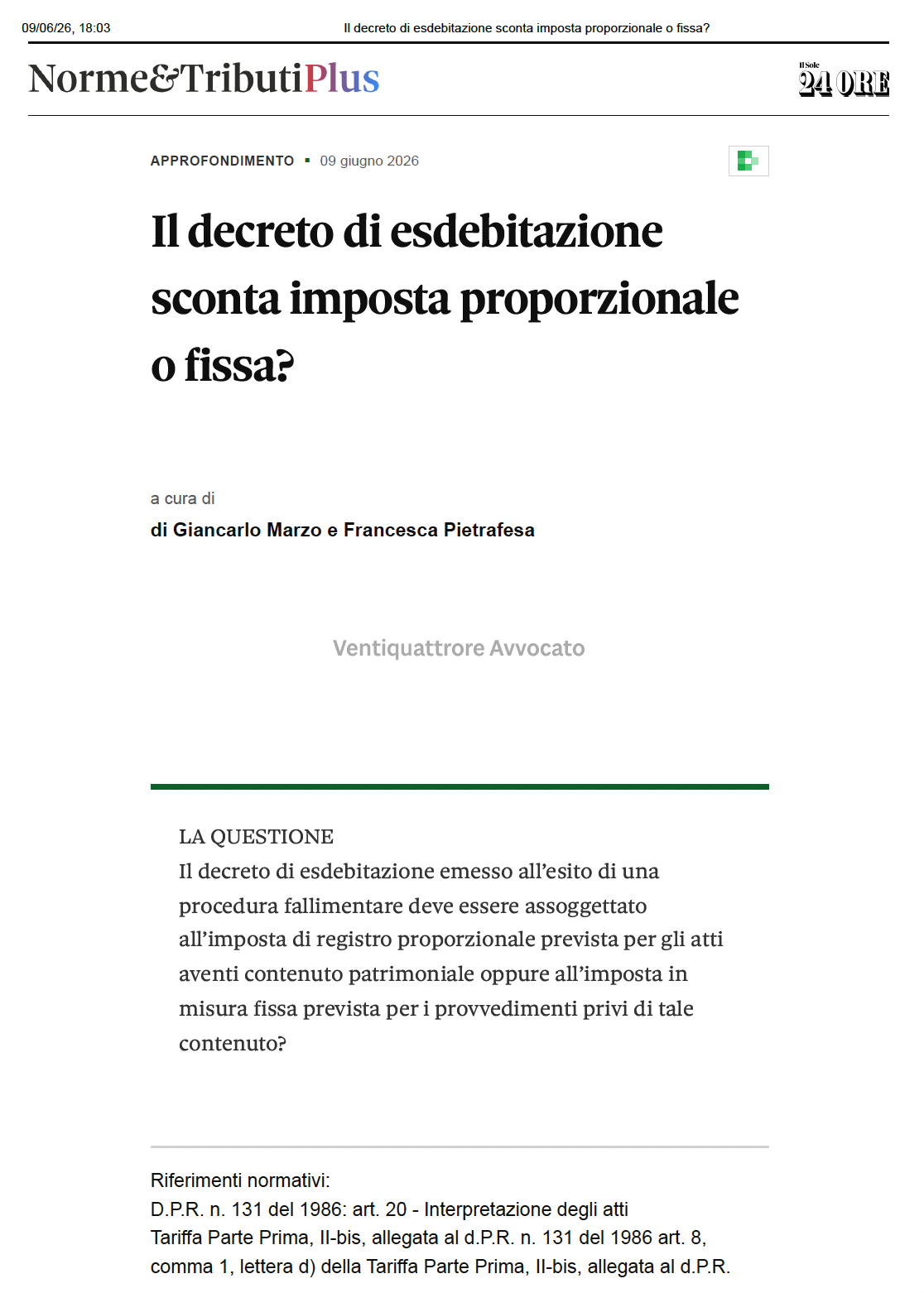
Is a debt discharge order subject to proportional or fixed tax?
by Giancarlo Marzo
THE ISSUE
Should a debt discharge order issued upon completion of bankruptcy proceedings be subject to proportional registration tax applicable to instruments with pecuniary content, or to the fixed amount of tax applicable to orders without such content?
Statutory references: D.P.R. n. 131 del 1986: Article 20 - Interpretation of instruments; Part One of the Tariff, II-bis, annexed to d.P.R. n. 131 del 1986, Article 8(1)(d).
The legal framework
A declaration of debt discharge releases an insolvent person from their debts and renders claims remaining unsatisfied in judicial liquidation or controlled liquidation proceedings unenforceable against the debtor. Upon the debtor's application and where specific requirements are met, the Court (Tribunale) grants this benefit by a debt discharge order to an insolvent but deserving person, pursuant to Articles 278 et seq. of D.Lgs. 12 January 2019, n. 14 (Business Crisis Code), as subsequently amended, which replaced the Bankruptcy Law (r.d. n. 267 del 1942) in its entirety.
Debt discharge does not render the claim itself unenforceable, but merely renders it unenforceable against the debtor, with the result that creditors retain their status and the ability to pursue co-obligors, guarantors and persons liable by way of recourse in respect of the discharged debtor. The primary purpose of this mechanism is to facilitate the debtor's economic and social reintegration by granting a "second chance", eliminating the paralysing effects of the remaining debt burden.
It is in this context that Article 20 of d.P.R. n. 131 del 1986 applies. In relation to determining the correct basis for registration tax, it provides that the tax must be applied according to the intrinsic nature and legal effects of the instrument submitted for registration, irrespective of the nomen iuris assigned to it by the parties. In other words, the provision embodies the fundamental principle of substance over form (and over the nomen assigned to the instrument by the parties).
Alongside this framework is Article 8 of Part One of the Tariff annexed to d.P.R. n. 131 del 1986, which governs the taxation of judicial instruments subject to registration. The rates and amounts vary according to the content of the order and, in particular, under subparagraphs (c) and (d) respectively, the provision distinguishes between orders declaring rights of a pecuniary nature, subject to proportional taxation, and orders without pecuniary content, which are instead subject to registration tax at a fixed amount.
Unenforceability of claims as the legal effect of a debt discharge order
The solution adopted by the Italian Supreme Court (Corte di Cassazione) is based on identifying the characteristic legal effect of a debt discharge order.
According to settled case law of the Italian Supreme Court (Corte di Cassazione), the substance-over-form principle required when determining registration tax under Article 20 TUR must be assessed by reference to the legal, rather than economic, effects of the instrument in question (see, most recently, Italian Supreme Court (Corte di Cassazione), no. 6060/2025, citing Italian Supreme Court (Corte di Cassazione), no. 7495/24 and Italian Supreme Court (Corte di Cassazione), no. 24647/2021). In other words, the Italian Supreme Court (Corte di Cassazione) has further clarified the principle of substance over form, specifying not only that registration tax must be determined by reference to the effects of the instrument rather than its designation, but also that only its legal effects (and not its economic effects) are to be taken into account.
Article 143 of the Bankruptcy Law (applicable ratione temporis to the case) expressly identifies the legal effect of a debt discharge order as the unenforceability of insolvency claims remaining unsatisfied. The order does not extinguish the remaining obligations or cancel the claims, but merely prevents creditors from taking enforcement action against the discharged debtor.
It follows that the obligation continues to exist as a matter of substantive law, while the possibility of obtaining satisfaction of the claim through compulsory enforcement falls away. Creditors' rights against any co-obligors, guarantors or persons liable by way of recourse remain unaffected, and the debtor remains subject to a natural obligation.
The Italian Supreme Court (Corte di Cassazione) also points out that discussing whether the debt discharge order is declaratory or constitutive in nature is not decisive for this purpose, since, even if its constitutive nature were accepted, the effect to be taken into account would still be its legal effect, namely the unenforceability of claims, rather than the mere economic impact that the order has on the discharged person's legal position.
Debt discharge therefore creates a particular personal legal condition, comparable to a status, characterised by the debtor's immunity from enforcement action in respect of remaining insolvency claims.
The non-pecuniary nature of a debt discharge order
The Italian Revenue Agency (Agenzia delle Entrate) had argued that the benefit arising from debt discharge brought about a change in the debtor's financial position sufficient to justify the application of registration tax at a proportional rate.
The Italian Supreme Court (Corte di Cassazione), however, rejected that approach, observing that the tax authority's argument ultimately attached significance to the order's economic effects rather than its legal effects. This distinction is decisive.
The economic advantage resulting from debt discharge is certainly evident: the debtor is no longer exposed to enforcement action by creditors in respect of the remaining debts. However, that effect does not coincide with the legal content of the order, which remains limited to declaring the claims unenforceable. Rather, it is merely an indirect consequence of the principal legal effect and cannot be relevant to classifying the order as having pecuniary content.
The Italian Supreme Court (Corte di Cassazione) also emphasised that a debt discharge order is characterised by its nature as a "determination focused on the personal aspect of the debtor's conduct", being distinguished precisely by its reward-based nature and purpose and by the legal effect it produces, namely the establishment of the legal status of a discharged debtor, consisting of the benefit of the unenforceability of claims remaining unsatisfied.
In practical terms, the consequence is that a debt discharge order must fall within the category of orders without pecuniary content, subject to registration at a fixed amount. Ultimately, the Italian Supreme Court (Corte di Cassazione) reached the same conclusion as the lower courts, but through a different legal analysis, based not on the absence of a manifestation of wealth, but on the non-pecuniary nature of the legal effect specific to a debt discharge order, namely the unenforceability of the remaining claims.
Italian Supreme Court (Corte di Cassazione), Civil Division V, 1 June 2026, no. 17174
The dispute arose from a notice by which the Italian Revenue Agency (Agenzia delle Entrate) had required a taxpayer to pay supplementary registration tax at the proportional rate of 1% in relation to a debt discharge order issued upon completion of bankruptcy proceedings, on the basis that the order had pecuniary content. Specifically, the Tax Office argued that the legal effect of rendering unsatisfied claims unenforceable, produced by the order, brought about a change in the debtor's financial position capable of characterising the order itself as an instrument with pecuniary content. This would entail the application of registration tax at a proportional rate.
The taxpayer, for her part, pointed out that a debt discharge order neither effects any transfer of assets nor extinguishes the remaining obligations, but merely renders unenforceable the claims left unsatisfied upon completion of the insolvency proceedings. Accordingly, a debt discharge order should be subject to the fixed amount of registration tax applicable to instruments without pecuniary content.
Having lost at both levels of the lower courts, the Italian Revenue Agency (Agenzia delle Entrate) lodged an appeal before the Italian Supreme Court (Corte di Cassazione) on two grounds. The first ground alleged infringement and misapplication of Article 20 of d.P.R. n. 131 del 1986 (known as the T.U.R.), and Article 8 of Part One of the Tariff annexed to the T.U.R., on the basis that the lower courts had failed to consider the constitutive effects of the debt discharge order, examining only the legal effects arising from debt discharge. The second ground alleged infringement of the same Article 20 T.U.R., on the basis that the Regional Tax Commission of Friuli Venezia Giulia had held that the order in question had no pecuniary content. That conclusion was based on the erroneous assumption that determining whether an instrument is taxable at a proportional rate requires establishing whether it produces a manifestation of wealth, whereas it is necessary to examine whether the order actually affects rights capable of economic valuation.
The Italian Supreme Court (Corte di Cassazione) dismissed the appeal brought by the Italian Revenue Agency (Agenzia delle Entrate), relying on the principle that debt discharge does not extinguish unsatisfied insolvency debts, but produces only the legal effect of preventing creditors from enforcing them and/or obtaining satisfaction. This aspect is legally relevant because it is fundamental to determining the correct registration tax applicable under Article 20 T.U.R. In short, having regard exclusively to its resulting legal effect, a debt discharge order has no pecuniary content, but recognises a personal legal condition characterised by the benefit of the unenforceability of the remaining claims. This therefore justifies taxation at a fixed amount.
Conclusions and final observations
The judgment forms part of a line of authority aimed at preserving the application of the principles governing the determination of registration tax, giving weight to the legal effects of the instrument and rejecting any attempt to base taxation on the economic consequences indirectly produced by the order. Specifically, the legal-effects criterion laid down in Article 20 T.U.R. cannot be extended to encompass indirect or consequential economic advantages.
In relation to registration tax, the taxable event remains anchored to the legal content of the instrument rather than the economic benefits that may arise from it, irrespective of whether the instrument is constitutive or declaratory in nature. The key point is the statement that debt discharge does not extinguish the remaining debts but merely renders them unenforceable. This clarification allows a clear distinction to be drawn between the legal effect and the evident, but nevertheless indirect, economic advantage resulting from it. The principle of law formulated by the Italian Supreme Court (Corte di Cassazione) may serve as a reference point for future disputes on the subject, establishing that a debt discharge order must be regarded as an instrument of a non-pecuniary nature and must therefore be subject to taxation at a fixed amount, respecting both the criterion for determining registration tax applicable to this type of order and the reward-based purpose inherent in debt discharge.
In practice — The actual case
Italian Supreme Court (Corte di Cassazione), Civil Division V, 1 June 2026, no. 17174
The headnote
For registration tax purposes, a debt discharge order must be subject to taxation at the fixed amount applicable to orders without pecuniary content. In determining the applicable registration tax, the legal effect of the order, consisting of the benefit of the unenforceability of unsatisfied insolvency claims, must be assessed, rather than the economic advantage indirectly resulting from it. A debt discharge order is characterised by its nature as a determination of the debtor's personal circumstances and eligibility for the benefit, and by the establishment of the legal status of a discharged debtor; it therefore cannot be classified as an order with pecuniary content.
The legal and statutory framework
The case examined centres on two different methods of determining the registration tax applicable to a debt discharge order.
On the one hand, Article 8(1)(c) of Part One of the Tariff annexed to the T.U.R. provides for taxation at a proportional rate for judicial instruments with pecuniary content.
On the other hand, Article 8(1)(d) of Part One of the Tariff annexed to the T.U.R. provides for taxation at a fixed amount for judicial instruments without pecuniary content.
To determine the correct registration tax to apply to a debt discharge order, Article 20 T.U.R. requires application of the fundamental principle that the instrument's "effects" prevail over its "designation". Over time, the case law of the Italian Supreme Court (Corte di Cassazione) has established the interpretation that the substance-over-form principle referred to in that provision must derive exclusively from an assessment of the instrument's legal, rather than economic, effects. It is precisely Article 143 of the Bankruptcy Law (applicable ratione temporis) that expressly identifies the legal effect of a debt discharge order as the unenforceability of insolvency claims that have not been satisfied in full.
The case in question
The dispute arose from a tax calculation notice by which the Italian Revenue Agency (Agenzia delle Entrate) had required a taxpayer to pay supplementary registration tax at the proportional rate of 1% in relation to a debt discharge order issued by the Court (Tribunale) upon completion of the bankruptcy proceedings of a limited liability company in which she had been a shareholder.
According to the tax authorities, the judicial order should have been subject to proportional taxation under Article 8(1)(c) of Part One of the Tariff annexed to the T.U.R., as an instrument with pecuniary content. The Tax Office considered that the debt discharge order produced a legal effect capable of altering the debtor's financial position by releasing her from the remaining debts left unsatisfied upon completion of the insolvency proceedings. In support of its argument, the tax authority considered that this benefit granted to the debtor would entail an advantage capable of economic valuation, sufficient to justify application of the proportional tax provided for orders declaring rights of a pecuniary nature.
The taxpayer therefore challenged the tax measure, arguing, on the contrary, that the debt discharge order neither effected any transfer of assets nor extinguished the remaining debts, but merely rendered the unsatisfied claims unenforceable. On this approach, the order was essentially reward-based and personal in nature, being intended to grant a deserving debtor the benefit of debt discharge where the conditions laid down in the Bankruptcy Law were met. This would entail application of registration tax at a fixed amount, which the taxpayer also sought on the basis that, if the State identified a legitimate opportunity to create a substantial tax claim of its own against the discharged debtor, the very rehabilitative purpose of debt discharge would be undermined.
The Provincial Tax Commission of Udine allowed the taxpayer's appeal. The decision was subsequently upheld by the Regional Tax Commission of Friuli Venezia Giulia, which considered that a debt discharge order could not be classified as an order with pecuniary content. The appellate court observed that, regardless of its classification as a declaratory or constitutive order, the instrument's substantive effect was to render claims unenforceable, rather than to extinguish the remaining obligations. Consequently, the order was classified among the orders referred to in Article 8(1)(d) of Part One of the Tariff annexed to the T.U.R., subject to registration at a fixed amount.
The Italian Revenue Agency (Agenzia delle Entrate) appealed against that decision to the Italian Supreme Court (Corte di Cassazione) on two grounds. The first ground of appeal alleged infringement of Article 20 of d.P.R. n. 131 del 1986 and Article 8 of Part One of the Tariff, arguing that the regional judges had wrongly given weight to the legal effects of debt discharge rather than the nature of the order, which, in the Tax Office's view, was constitutive and capable of altering the debtor's legal position by declaring the remaining claims unenforceable. In the second ground of appeal, the Italian Revenue Agency (Agenzia delle Entrate) complained that the order's pecuniary content had been wrongly excluded, pointing out that the releasing effect of debt discharge was capable of economic valuation and should therefore have entailed application of proportional tax.
The Italian Supreme Court (Corte di Cassazione) was therefore called upon to determine whether, for registration tax purposes, a debt discharge order should be classified as an order with pecuniary content, subject to proportional taxation, or as an order without such content, subject to tax at a fixed amount. The Court dismissed the appeal in its entirety, reiterating, first, that the determination of registration tax applicable to a debt discharge order must refer to the legal, rather than economic, effects arising from the instrument. Secondly, a debt discharge order, being the culmination of an assessment of the debtor's personal circumstances and eligibility for the benefit, and granting the debtor the benefit of the unenforceability of claims remaining unsatisfied without extinguishing them, cannot be classified as an instrument with pecuniary content. It follows that registration tax must be applied at a fixed amount.
Concluding observations
The Court's judgment crystallises the already well-established principle that, when classifying the content of a judicial instrument such as a debt discharge order, only the legal effect produced by the instrument is relevant. Any other economic effect indirectly resulting from the instrument cannot serve as the criterion for determining the correct registration tax applicable to the order under consideration. This is consistent with the primary purpose of debt discharge, namely to provide the "honest but unfortunate" debtor with a second chance.
Accordingly, the legal effect specific to a debt discharge order is solely to grant the debtor the benefit of the unenforceability of unsatisfied insolvency claims. In conclusion, the unsatisfied claims and/or debts continue to exist, with only their enforcement and/or satisfaction being prevented.
Selected case law — Headnotes
Italian Supreme Court (Corte di Cassazione), Civil Division V, Order, 28 May 2026, no. 16760
For the substantive classification of an instrument, the interpreter must first assess which elements are to be considered internal to the instrument submitted for registration, so as to identify those external to it, which will remain irrelevant and unusable (save for the distinct situation under Article 10-bis of legge 212/00, cited above). This process of classifying and legally characterising the transaction must be directed towards identifying the tax regime applicable to the instrument, taking into account, on the one hand, its intrinsic nature and legal (not economic) effects and, on the other, an individual and self-contained analysis of it according to the model — still inherent in the legal system (Constitutional Court, cited above) — of a "tax on instruments".
Italian Supreme Court (Corte di Cassazione), Civil Division V, Order, 6 March 2025, no. 6060
The wording and rationale of Article 20 TUR retain the fundamental principle of substance over form (and over the nomen assigned to the instrument by the parties). In relation to a tax on instruments, that precedence must in any event derive from an assessment of the instrument's "legal effects", rather than its economic effects.
The transfer of all the shares in a company, even if encompassing the entire business assets, cannot be recharacterised as a transfer of a business for registration tax purposes under Article 20 D.P.R. n. 131/1986, which applies to the intrinsic nature and legal effects of the instrument, excluding any relevance of the economic purposes pursued by the parties.
Italian Supreme Court (Corte di Cassazione), Civil Division V, Order, 20 March 2024, no. 7495
Where all the equity interests in a company or partnership are transferred, registration tax is always calculated at a fixed amount under Article 11 of Part I of the Tariff, TUR, since, in the absence of extratextual elements or connected instruments, the tax authorities are precluded by Article 20 TUR from recharacterising the transaction as an indirect transfer of a business; consistently with the contract's intrinsic nature and legal effects, the transfer of the business belonging to the partnership or company remains outside its scope.
Italian Supreme Court (Corte di Cassazione), Civil Division V, 13 December 2023, no. 34917
Registration tax must be applied according to the intrinsic nature and legal effects of the instrument submitted for registration, even where its designation or apparent form does not correspond to them, pursuant to Article 20 of D.P.R. n. 131 del 1986. Accordingly, the substantive precedence of the conditions for taxation over the instrument's designation or apparent form must be asserted by the tax authorities, albeit within the limits imposed on interpretation by that provision, namely by reference to the instrument's intrinsic features. It follows that, for registration tax purposes, the mere transfer of an equity interest does not produce the legal effects specific to a transfer of a business (even where the instrument provides for the separate transfer of the company's debts and claims), nor can it be regarded as expressing the transfer of an organised productive asset complex capable, under Article 2555 cod. civ., of constituting a business or a branch thereof.