
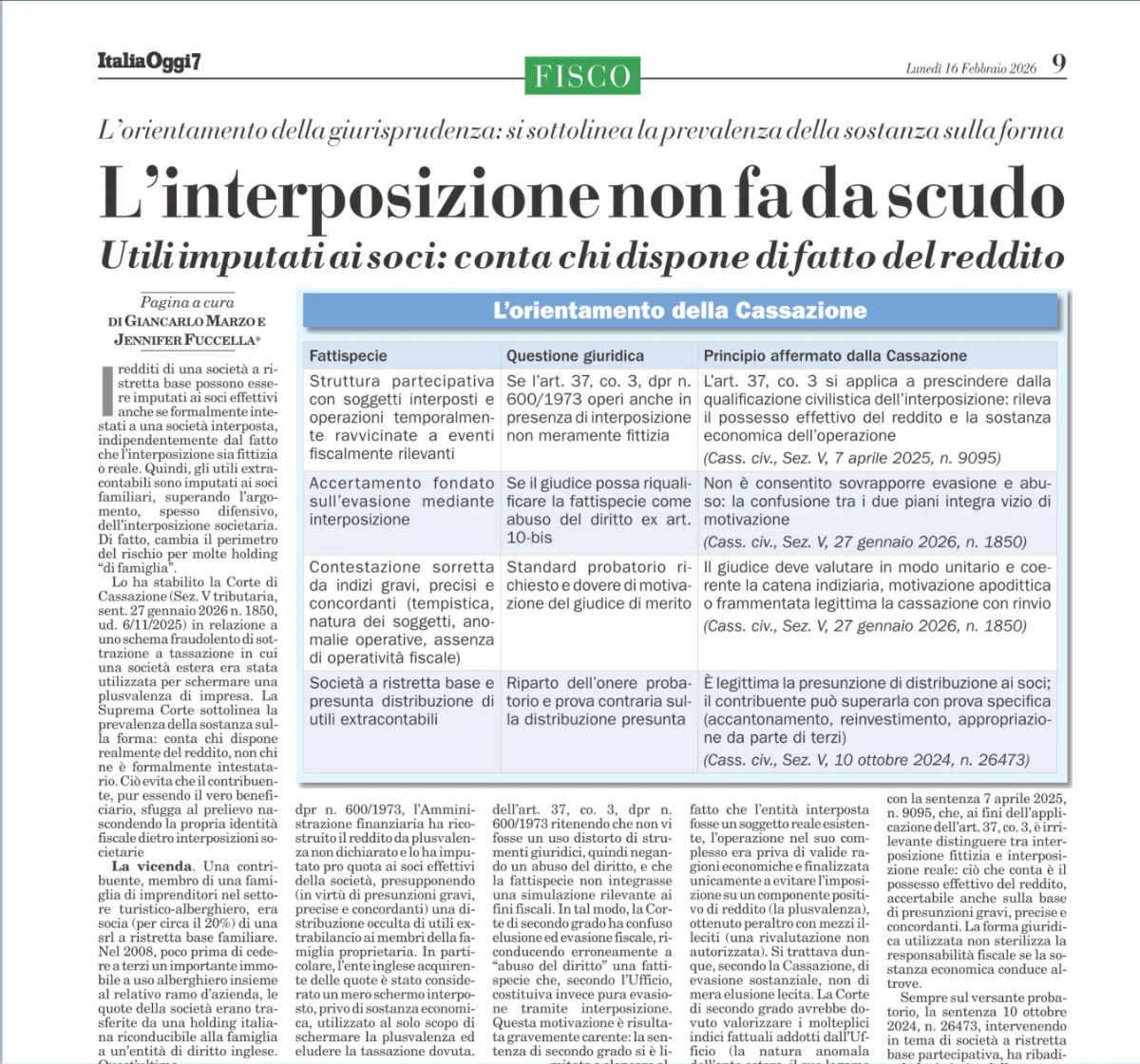
Corporate interposition and closely held companies: profits attributed to the actual shareholders
The Italian Supreme Court (Corte di Cassazione), in judgment no. 1850 of 27 January 2026, redefined the scope of risk for many “family” holding companies, establishing a fundamental principle in tax matters: substance prevails over form.The primacy of substance over form in closely held companies
Consequently, the unrecorded profits of a closely held company may be attributed to the actual family shareholders, even where formally held in the name of an interposed company. This ruling clarifies that corporate interposition does not provide a shield against the tax authorities, reaffirming the clear primacy of economic substance over legal form.The specific case: corporate interposition through a foreign entity
The case concerned a taxpayer who was a shareholder in a closely held family limited liability company (srl) operating in the tourism and hotel sector. Before the sale of a property, the company's shares were transferred from an Italian holding company to an entity governed by English law. The tax authorities considered the English entity to be a mere interposed entity, lacking economic substance, whose sole purpose was to shield the business capital gain in order to avoid taxation.Interposition, Tax Evasion and Abuse of Law
The judicial approach clarifies several legal issues relating to corporate interposition and tax evasion:- Art. 37, co. 3, DPR n. 600/1973: The provision applies regardless of how the interposition is classified under civil law. It does not matter whether the interposition is fictitious or genuine; what matters is establishing who has actual possession of the income.
- Economic substance of transactions: The legal form adopted cannot negate tax liability if the transaction lacks valid economic reasons and constitutes evasion in substance.
- Distinction between legal concepts: The judges clarified that tax evasion cannot be conflated with abuse of law. Confusing these two concepts constitutes a defect in the reasoning.
Presumption of Profit Distribution and Burden of Proof
For closely held companies, the presumption of a concealed distribution of profits to shareholders is legitimate. The taxpayer may, however, rebut this presumption by providing specific evidence to the contrary. This may consist of demonstrating:- Retention of profits
- Reinvestment of profits
- Appropriation of profits by third parties


