
Key Points
- The superbonus is entering its final stretch: invoice discounts and tax credit transfers remain available for 2026 expenditure, but only for the "remaining" categories.
- Since 23 July 2026, a new form has been available for notifying the Italian Revenue Agency (Agenzia delle Entrate) of invoice discounts and the first transfer of tax credits for 2026 superbonus expenditure (decision ref. no. 211701 of 17 July 2026).
- It concerns only properties damaged by the 2009 and 2016 earthquakes, within a €400 million funding ceiling, of which €70 million is reserved for Abruzzo.
- Electronic submission must take place by 16 March 2027: the deadline is mandatory and the remissione in bonis procedure is excluded.
- Automated checks will cross-reference notifications against data from government reconstruction offices: inconsistent notifications will be rejected.
The 110% relief remains available through invoice discounts or transfers: who can still benefit and how
The superbonus is entering its final stretch with a tailored, streamlined form: invoice discounts and tax credit transfers remain available for 2026 expenditure, but only for the "remaining" categories. Since 23 July 2026, a new form has been available for notifying the Italian Revenue Agency (Agenzia delle Entrate) of invoice discounts and the first transfer of tax credits for 2026 superbonus expenditure. However, it concerns only properties damaged by the 2009 and 2016 earthquakes, within a €400 million funding ceiling. The deadline is 16 March 2027.
By decision ref. no. 211701 of 17 July 2026, the Italian Revenue Agency (Agenzia delle Entrate) approved the updated form, together with instructions and technical specifications, for notifying the two alternatives to the tax deduction: a discount applied by the contractor directly on the invoice and the first transfer of the tax credit (art. 121 of dl n. 34/2020).
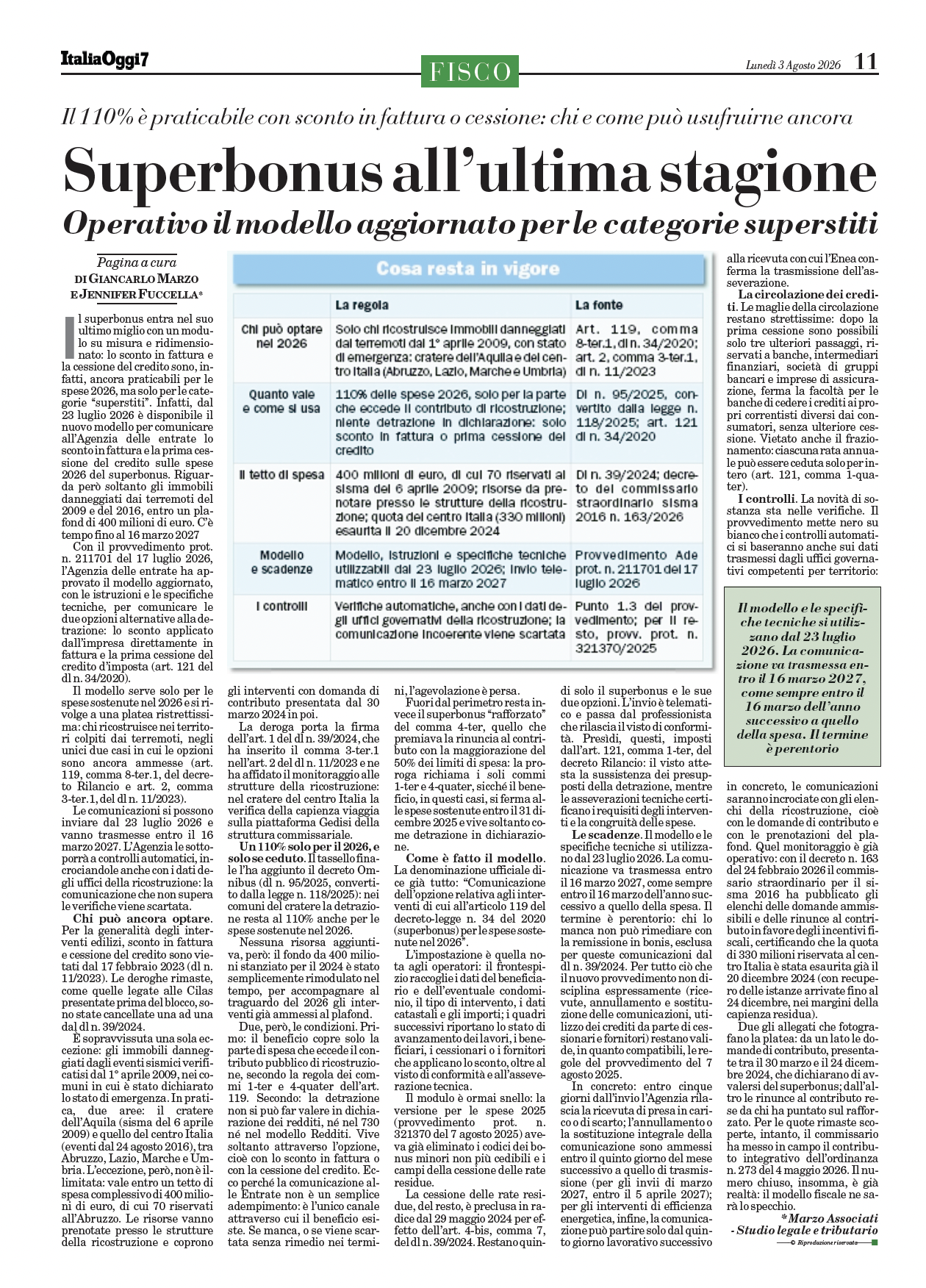
What remains in force
| | The rule | The source |
| --- | --- | --- |
| Who can exercise the options in 2026 | Only those rebuilding properties damaged by earthquakes occurring from 1 April 2009 onwards, where a state of emergency was declared: the L'Aquila and central Italy earthquake zones (Abruzzo, Lazio, Marche and Umbria) | Art. 119, paragraph 8-ter.1, dl n. 34/2020; art. 2, paragraph 3-ter.1, dl n. 11/2023 |
| Value and use of the relief | 110% of 2026 expenditure, only for the portion exceeding the reconstruction grant; no deduction in the tax return: only an invoice discount or the first transfer of the tax credit | Dl n. 95/2025, converted by legge n. 118/2025; art. 121 dl n. 34/2020 |
| The spending cap | €400 million, of which €70 million is reserved for Abruzzo; funding must be reserved with the reconstruction bodies; the central Italy allocation (€330 million) was exhausted on 20 December 2024 | Dl n. 39/2024; decree of the Extraordinary Commissioner for the 2016 Earthquake n. 163/2026 |
| Form and deadlines | Form, instructions and technical specifications available for use from 23 July 2026; electronic submission by 16 March 2027 | Italian Revenue Agency decision ref. no. 211701 of 17 July 2026 |
| Checks | Automated checks, including against data from government reconstruction offices; inconsistent notifications are rejected | Point 1.3 of the decision; for other matters, decision ref. no. 321370/2025 |
The form is solely for expenditure incurred in 2026 and is intended for a very limited group: those rebuilding in earthquake-affected areas, in the only two cases where the options remain permitted (art. 119, paragraph 8-ter.1, of the Relaunch Decree and art. 2, paragraph 3-ter.1, of dl n. 11/2023).
Notifications may be submitted from 23 July 2026 and must be sent by 16 March 2027. The Agency will subject them to automated checks, including cross-referencing them against data from reconstruction offices: notifications that fail the checks will be rejected.
Who can still exercise the options
For building works generally, invoice discounts and tax credit transfers have been prohibited since 17 February 2023 (dl n. 11/2023). The remaining exemptions, such as those linked to Cilas notices submitted before the ban, were removed one by one by dl n. 39/2024.
Only one exception has survived: properties damaged by seismic events occurring from 1 April 2009 onwards, in municipalities where a state of emergency was declared. In practice, this covers two areas: the L'Aquila earthquake zone (earthquake of 6 April 2009) and the central Italy earthquake zone (events from 24 August 2016 onwards), across Abruzzo, Lazio, Marche and Umbria. The exception is not unlimited, however: it applies within an overall spending cap of €400 million, of which €70 million is reserved for Abruzzo. Funding must be reserved with the reconstruction bodies and covers works for which grant applications were submitted on or after 30 March 2024.
The exemption derives from art. 1 of dl n. 39/2024, which inserted paragraph 3-ter.1 into art. 2 of dl n. 11/2023 and entrusted monitoring to the reconstruction bodies: in the central Italy earthquake zone, checks on available funding are carried out through the Commissioner's Gedisi platform.
110% relief only for 2026, and only if transferred
The final element was added by the Omnibus Decree (dl n. 95/2025, converted by legge n. 118/2025): in municipalities within the earthquake zones, the deduction remains at 110% for expenditure incurred in 2026 as well.
There is no additional funding, however: the €400 million fund allocated for 2024 has simply been rescheduled over time, to carry works already admitted within the funding ceiling through to the 2026 endpoint.
There are, however, two conditions. First: the relief covers only the portion of expenditure exceeding the public reconstruction grant, under the rule in paragraphs 1-ter and 4-quater of art. 119. Second: the deduction cannot be claimed in a tax return, whether on form 730 or the Redditi form. It is available only by exercising an option, namely an invoice discount or a tax credit transfer. This is why notification to the Revenue Agency is not merely a compliance requirement: it is the only route through which the relief is available. If it is missing, or is rejected without being remedied within the deadline, the relief is lost.
The "enhanced" superbonus under paragraph 4-ter, which rewarded waiver of the grant with a 50% increase in the expenditure limits, remains outside the scope: the extension refers only to paragraphs 1-ter and 4-quater, so in these cases the relief is limited to expenditure incurred by 31 December 2025 and is available only as a deduction in the tax return.
How the form is structured
The official name says it all: "Notification of the option relating to works under article 119 of decreto-legge n. 34 of 2020 (superbonus) for expenditure incurred in 2026".
The layout is familiar to practitioners: the cover page records the details of the beneficiary and any condominium, the type of works, the cadastral details and the amounts; the subsequent sections set out the stage of completion of the works, the beneficiaries, the transferees or suppliers applying the discount, as well as the tax compliance certificate and the technical certification.
The form is now streamlined: the version for 2025 expenditure (decision ref. no. 321370 of 7 August 2025) had already removed the codes for minor incentives that could no longer be transferred and the fields for transferring remaining instalments.
Transfers of remaining instalments have, in any event, been prohibited outright since 29 May 2024 under art. 4-bis, paragraph 7, of dl n. 39/2024. Only the superbonus and its two options therefore remain.
Submission is electronic and is made through the professional issuing the tax compliance certificate. These safeguards are required by art. 121, paragraph 1-ter, of the Relaunch Decree: the tax compliance certificate confirms that the conditions for the deduction are met, while the technical certifications confirm that the works meet the requirements and that the expenditure is reasonable.
Deadlines
The form and technical specifications may be used from 23 July 2026. The notification must be submitted by 16 March 2027, as always by 16 March of the year following that in which the expenditure was incurred. The deadline is mandatory: anyone who misses it cannot remedy the failure through remissione in bonis, which dl n. 39/2024 excludes for these notifications. For all matters not expressly governed by the new decision (receipts, cancellation and replacement of notifications, use of credits by transferees and suppliers), the rules in the decision of 7 August 2025 remain applicable insofar as they are compatible.
In practical terms: within five days of submission, the Agency issues a receipt confirming acceptance or rejection; cancellation or replacement of the notification in full is permitted by the fifth day of the month following submission (for submissions in March 2027, by 5 April 2027); finally, for energy-efficiency works, the notification may be submitted only from the fifth working day after the receipt by which Enea confirms transmission of the technical certification.
Onward transfers of credits
The rules on onward transfers remain very restrictive: after the first transfer, only three further transfers are possible, restricted to banks, financial intermediaries, companies within banking groups and insurance undertakings, without prejudice to banks' right to transfer credits to their account holders other than consumers, with no further transfer permitted. Splitting is also prohibited: each annual instalment may be transferred only in full (art. 121, paragraph 1-quater).
Checks
The substantive change concerns the checks. The decision expressly states that automated checks will also be based on data transmitted by the government offices with territorial responsibility: in practice, notifications will be cross-referenced against reconstruction lists, namely grant applications and funding reservations within the ceiling. That monitoring is already operational: by decree n. 163 of 24 February 2026, the Extraordinary Commissioner for the 2016 Earthquake published the lists of eligible applications and waivers of grants in favour of tax incentives, certifying that the €330 million allocation reserved for central Italy had already been exhausted on 20 December 2024 (with applications received up to 24 December also included to the extent of the remaining funding available).
Two annexes set out the eligible groups: on the one hand, grant applications submitted between 30 March and 24 December 2024 declaring that the applicants intend to use the superbonus; on the other, grant waivers submitted by those who opted for the enhanced relief. Meanwhile, for the portions left uncovered, the Commissioner has introduced the supplementary grant under ordinance n. 273 of 4 May 2026. In short, the closed pool of beneficiaries is already a reality: the tax form will reflect it.
Article published in ItaliaOggi7 on 3 August 2026, by Giancarlo Marzo — Marzo Associati, Law and Tax Firm.
Frequently Asked Questions
Who can still opt for an invoice discount or tax credit transfer in 2026?
Only those rebuilding properties damaged by earthquakes occurring from 1 April 2009 onwards in municipalities where a state of emergency was declared: the L'Aquila earthquake zone (earthquake of 6 April 2009) and the central Italy earthquake zone (events from 24 August 2016 onwards), across Abruzzo, Lazio, Marche and Umbria.
When can the new form be used and what is the submission deadline?
The form, instructions and technical specifications approved by decision ref. no. 211701 of 17 July 2026 may be used from 23 July 2026; the notification must be submitted by 16 March 2027. The deadline is mandatory and remissione in bonis is excluded by dl n. 39/2024.
What is the value of the relief and how is it used?
110% of 2026 expenditure, only for the portion exceeding the reconstruction grant. The deduction cannot be claimed in a tax return: it is available only through an invoice discount or the first transfer of the tax credit.
Is there a spending cap?
Yes: €400 million, of which €70 million is reserved for Abruzzo. Funding must be reserved with the reconstruction bodies; the central Italy allocation (€330 million) was exhausted on 20 December 2024.
How can credits be transferred after the first transfer?
After the first transfer, only three further transfers are possible, restricted to banks, financial intermediaries, companies within banking groups and insurance undertakings; banks may transfer credits to their account holders other than consumers, with no further transfer permitted. Splitting is prohibited: each annual instalment may be transferred only in full (art. 121, paragraph 1-quater).


